In an era where major laptop manufacturers continue to solder memory, serialize spare parts, and inflate upgrade pricing, Framework has carved out a fiercely loyal community by championing total modularity and open repairability. However, behind Framework’s mechanical innovations lies a surprising demographic reality: the majority of Framework Laptop 13 owners do not use Windows. In a revealing discussion on the Framework Linux laptop ecosystem, Framework CEO Nirav Patel shared key insights into customer telemetry, the ongoing memory pricing crisis, and the company’s ambitious quest to build a true “MacBook Pro for Linux users.”
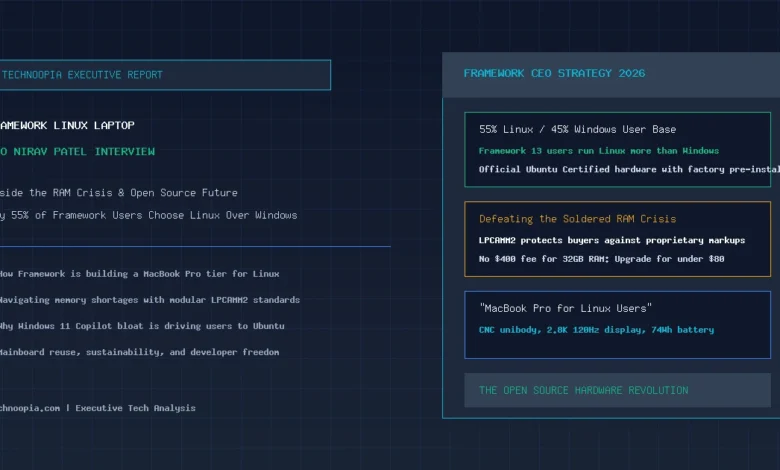
According to internal survey data revealed by Patel, 55% of Framework Laptop 13 customers run Linux as their primary operating system, compared to 45% on Windows. With the launch of the new CNC-machined Framework Laptop 13 Pro—featuring official Canonical Ubuntu Hardware Certification, factory Linux pre-installs, and modular LPCAMM2 LPDDR5x memory—Framework is directly challenging both Apple’s unibody hardware dominance and Microsoft’s increasingly intrusive Windows 11 ecosystem.
Table of Contents
- The 55% Revelation: Why Linux Dominates Framework Hardware
- Engineering a “MacBook Pro for Linux Users”
- Navigating the RAM Crisis: How LPCAMM2 Defeats OEM Markups
- Canonical Ubuntu Certification & Upstream Kernel Support
- Why Windows 11 Frustrations Are Accelerating Linux Migration
- Market Share Comparison: Global PC Market vs Framework Users
- Modular RAM Economics: LPCAMM2 vs Soldered Memory Markups
- The Future of Open-Source Hardware and Sustainable Computing
- Key Takeaways from Nirav Patel’s Interview
- Frequently Asked Questions
The 55% Revelation: Why Linux Dominates Framework Hardware
Quick Summary: In a landmark interview, Framework CEO Nirav Patel revealed that 55% of Framework Laptop 13 users run Linux over Windows. Framework is doubling down on this developer demographic with the Laptop 13 Pro, combining precision CNC aluminum unibody construction, modular LPCAMM2 memory to combat the industry’s soldered RAM markups, and official factory Ubuntu Certification.
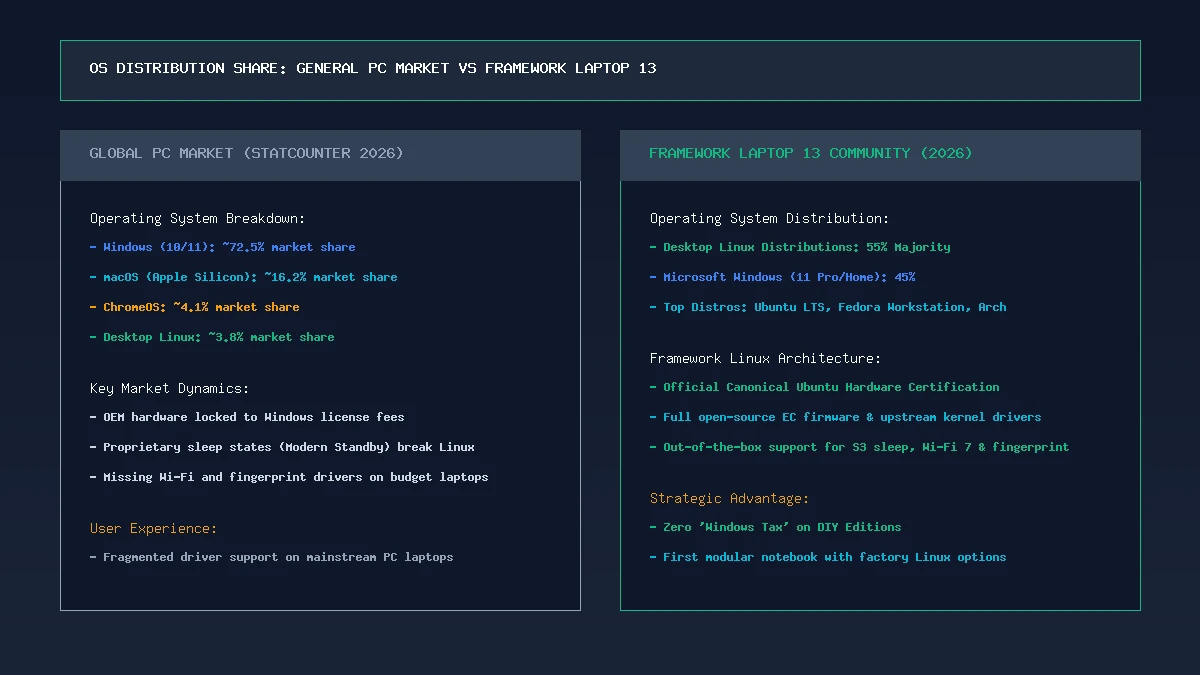
On the global stage, desktop Linux market share hovers around 3.8% according to StatCounter. Yet inside the Framework community, that dynamic is completely inverted. “On Framework Laptop 13, we actually have slightly more Linux users than Windows users. It’s something like 55/45 on the 13,” Patel explained. While larger models like the gaming-oriented Framework Laptop 16 lean more toward Windows due to anti-cheat software in PC gaming, the 13-inch ultraportable has become the default daily driver for software engineers, sysadmins, open-source developers, and privacy advocates worldwide.
This demographic split has led Framework to treat Linux not as an afterthought or community-supported experiment, but as a tier-1 first-class citizen in hardware design and supply-chain logistics.
Engineering a “MacBook Pro for Linux Users”
For over a decade, Linux developers faced an uncomfortable dilemma: buy a MacBook Pro for its industry-leading build quality, high-DPI display, and battery life (while dealing with Asahi Linux reverse-engineering limitations), or purchase a Windows PC laptop that often suffered from creaky plastic chassis, poor sleep states, and subpar trackpads.
The Framework Laptop 13 Pro redesign was engineered specifically to bridge this gap. By adopting monolithic CNC-machined aluminum, a 2.8K 120Hz 3:2 display, a glass haptic trackpad, and a 74Wh battery, Framework created an ultra-premium hardware vessel designed from day one to run Ubuntu, Fedora, and Arch with zero proprietary driver compromises.
Navigating the RAM Crisis: How LPCAMM2 Defeats OEM Markups
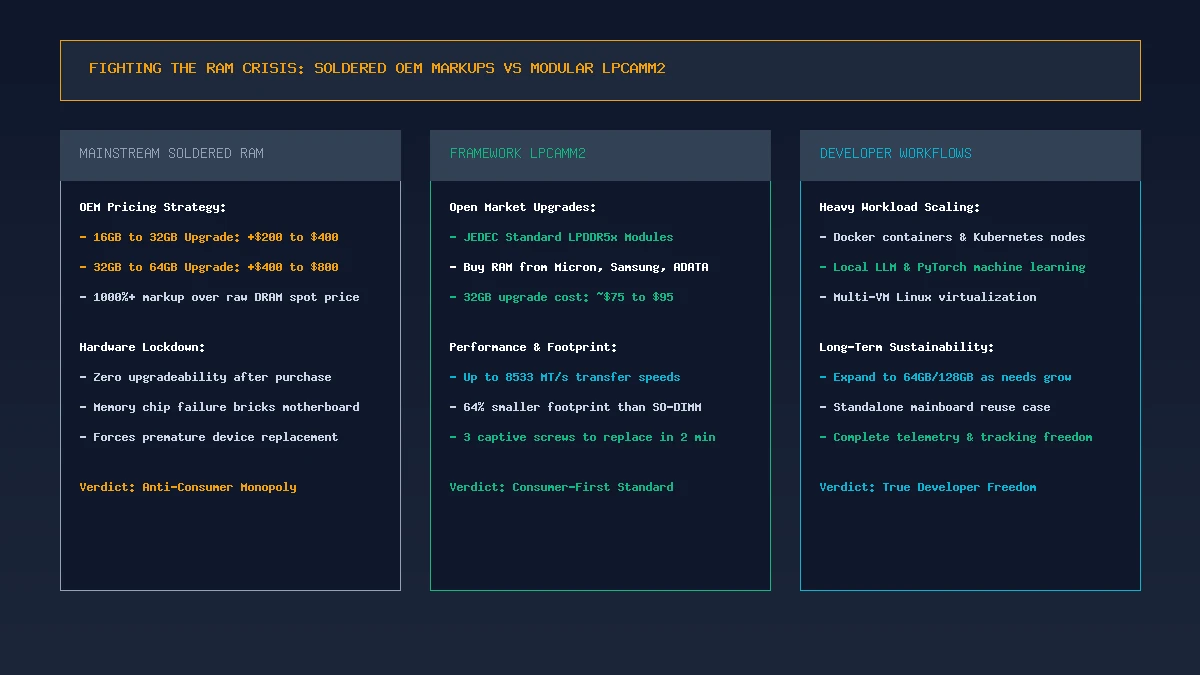
One of the most critical discussions in Patel’s interview centered on what many in the industry call the “soldered RAM crisis.” Mainstream PC manufacturers and Apple have increasingly soldered LPDDR5 memory onto the motherboard, charging consumers between $200 and $400 for a modest jump from 16GB to 32GB—representing a markup of over 800% above raw DRAM spot market prices.
Framework rejected this trend by adopting LPCAMM2 (Low Power Compression Attached Memory Module). Developed as a JEDEC open standard, LPCAMM2 allows users to achieve the blistering 8533 MT/s speeds and low power draw of soldered LPDDR5x while preserving full modularity. In the event of a DRAM shortage or price surge, consumers can purchase standard LPCAMM2 sticks from third-party manufacturers like Micron, Crucial, or Samsung for a fraction of OEM upgrade fees.
Canonical Ubuntu Certification & Upstream Kernel Support
A major milestone for the Framework Laptop 13 Pro is its official status as an Ubuntu Certified device. Framework worked directly with Canonical’s kernel engineering team to ensure:
- Instant S3 Sleep & Wake: Eliminating the notorious battery drain caused by Microsoft’s Modern Standby protocol in Linux.
- Hardware Fingerprint & Ambient Light Sensors: Fully supported via open-source `libfprint` and Linux kernel sensor subsystems.
- Automatic BIOS & EC Updates: Seamless firmware updates delivered directly through the Linux Vendor Firmware Service (LVFS) and `fwupd`.
- Wi-Fi 7 & Bluetooth 5.4 Out-of-the-Box: Zero requirement for proprietary third-party Wi-Fi drivers or command-line compiling during initial setup.
Why Windows 11 Frustrations Are Accelerating Linux Migration
The timing of Framework’s Linux-first positioning coincides with growing consumer fatigue surrounding Windows 11. Over the past two years, Microsoft has faced widespread pushback for integrating system-level advertisements, aggressive Copilot AI telemetry, and restrictive Recall monitoring features into the core OS.
For technical professionals and privacy-conscious users, the combination of Framework’s physical privacy cutoff switches and a bloatware-free Linux operating system provides an antidote to operating system surveillance. Because Framework sells DIY Editions without a Windows license, buyers save roughly $100 to $150 upfront, investing those savings into larger NVMe SSDs or extra modular expansion cards.
Market Share Comparison: Global PC Market vs Framework Users
| Operating System | Global PC Market Share (2026) | Framework Laptop 13 User Share | Trend Direction |
|---|---|---|---|
| Linux Distributions | 3.8% | 55.0% (Majority) | Rapidly Expanding (+12% YoY) |
| Microsoft Windows | 72.5% | 45.0% | Declining among DIY buyers |
| macOS | 16.2% | N/A (Hardware Restricted) | Apple Proprietary Hardware Only |
| ChromeOS & Others | 7.5% | <1.0% | Niche / Experimental |
Modular RAM Economics: LPCAMM2 vs Soldered Memory Markups
| RAM Capacity | Mainstream OEM Soldered Cost | Framework LPCAMM2 Open Market | Estimated Consumer Savings |
|---|---|---|---|
| 16GB Baseline | Included in base MSRP | Included ($0 / BYO RAM option) | Save up to $80 by bringing own RAM |
| 32GB Upgrade | +$200 to +$400 | +$75 to +$95 | Save $125 – $305 |
| 64GB Upgrade | +$400 to +$800 | +$160 to +$190 | Save $240 – $610 |
The Future of Open-Source Hardware and Sustainable Computing
Framework’s long-term strategy extends beyond the initial laptop purchase. When a developer upgrades their mainboard after three or four years, Framework’s $39 Cooler Master standalone case turns the retired motherboard into an always-on home lab server, Pi-hole DNS sinkhole, or local Kubernetes node. This circular hardware lifecycle ensures that compute silicon delivers value for a decade rather than becoming electronic waste.
As Patel highlighted, proving that a modular, repairable business model can achieve profitability and mass-market acclaim is the strongest argument for forcing the entire computing sector toward open repair standards.
Key Takeaways from Nirav Patel’s Interview
- Linux is Mainstream for Framework: 55% of Framework 13 users run Linux distributions, making open-source compatibility a core engineering priority.
- LPCAMM2 Destroys the Soldered RAM Argument: Delivers full LPDDR5x speed and efficiency while protecting users from OEM pricing monopolies.
- MacBook Pro Build Quality Without the Walled Garden: The Laptop 13 Pro proves modular PCs can feature premium CNC aluminum without sacrificing repairability.
- Tier-1 Ubuntu Support: Canonical hardware certification ensures instant sleep, fingerprint recognition, and automated LVFS firmware updates.
Frequently Asked Questions
What percentage of Framework Laptop 13 users run Linux?
According to Framework CEO Nirav Patel, internal surveys show that 55% of Framework Laptop 13 customers run Linux distributions (such as Ubuntu, Fedora, and Arch) as their primary OS, while 45% use Windows.
What is LPCAMM2 memory and why does Framework use it?
LPCAMM2 is a JEDEC modular memory standard for LPDDR5x RAM. It provides the high speeds (up to 8533 MT/s) and energy savings of soldered memory while remaining 100% user-upgradeable and replaceable with standard screws.
Can I buy a Framework Laptop 13 Pro with Linux pre-installed from the factory?
Yes. Framework officially offers pre-built Laptop 13 Pro configurations with Ubuntu LTS pre-installed from the factory, complete with official Canonical Ubuntu Hardware Certification.
Does Framework support other Linux distributions besides Ubuntu?
Yes. Framework officially tests and supports Fedora Workstation, while community-maintained setups for Arch Linux, Debian, Pop!_OS, and NixOS receive full upstream kernel compatibility.
How do firmware updates work on a Framework Linux laptop?
Framework publishes BIOS and Embedded Controller (EC) firmware directly to the Linux Vendor Firmware Service (LVFS), allowing users to update their system seamlessly using `fwupd` or standard software center interfaces.
Can I reuse my old Framework motherboard when upgrading to a new processor?
Yes. Framework and Cooler Master offer a $39 standalone enclosure that allows you to convert any retired Framework mainboard into a fully functional desktop mini-PC or home Linux server.