
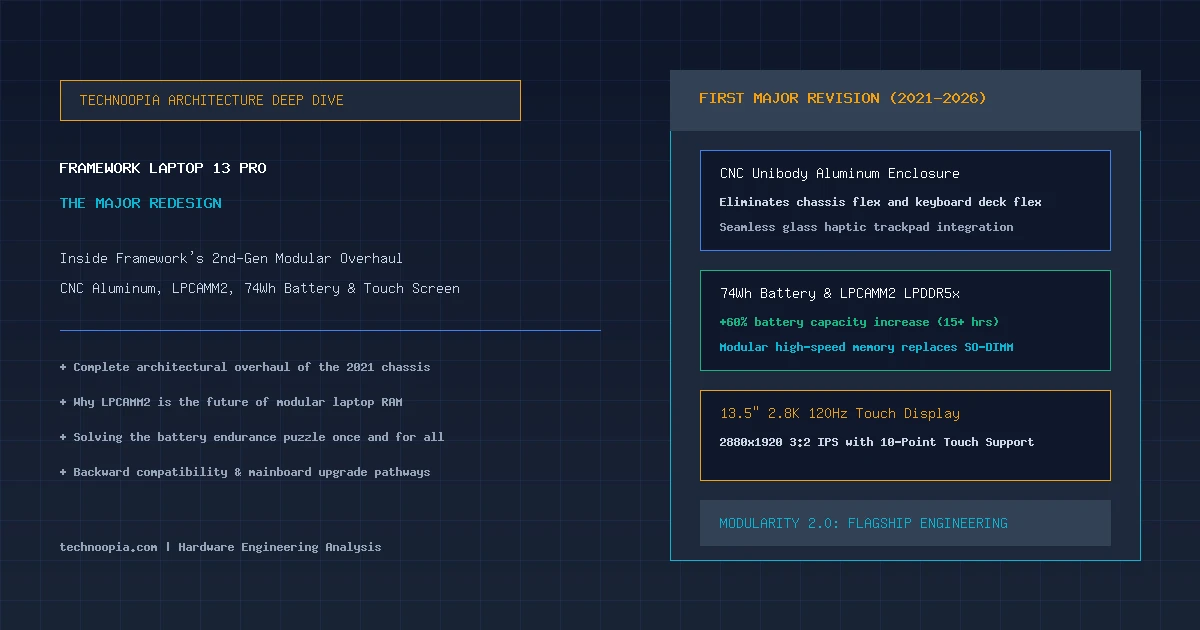
When the original Framework Laptop debuted in 2021, it felt like an audacious engineering rebellion against the consumer electronics industry. In a market dominated by glued-down batteries, soldered memory, and anti-repair DRM, Framework proved that a thin-and-light laptop could be fully modular, completely repairable, and easily upgradeable. However, for five years, Framework’s innovation focused primarily on generational mainboard swaps while maintaining the exact same physical enclosure. Today, the Framework Laptop 13 Pro redesign marks the first major architectural revision to the company’s flagship machine, redefining what modular hardware can achieve in 2026.
This second-generation overhaul touches nearly every structural and mechanical component: a monolithic CNC-machined aluminum chassis, a vibrant 13.5-inch 2.8K 120Hz 3:2 touchscreen display, a high-density 74Wh battery, a precision glass haptic trackpad, and the consumer PC industry’s boldest implementation of modular LPCAMM2 LPDDR5x memory. Here is an in-depth analysis of Framework’s engineering breakthroughs, structural decisions, and the long-term implications for the modular computing ecosystem.
Table of Contents
- Why Framework Redesigned the Chassis After Five Years
- Structural Breakthrough: Moving from Stamped to CNC Aluminum
- The LPCAMM2 Revolution: High-Speed Modular Memory Explained
- Display Evolution: 2.8K, 120Hz VRR, and 10-Point Touch Support
- Thermal Architecture and 74Wh Battery Engineering
- Input Advancements: Glass Haptic Trackpad & Physical Privacy Switches
- The Backward Compatibility Balance: What Changes and What Stays
- Generational Comparison: Framework 13 (Gen 1) vs Framework 13 Pro
- The Right-to-Repair Blueprint for the Next Decade
- Pros and Cons of the Redesign
- Verdict on the Framework Laptop 13 Pro Redesign
- Frequently Asked Questions
Why Framework Redesigned the Chassis After Five Years
Quick Summary: The Framework Laptop 13 Pro redesign is the first comprehensive physical overhaul of the modular laptop since 2021. It transitions from stamped aluminum to a rigid CNC unibody, integrates a larger 74Wh battery (+60% capacity), introduces modular LPCAMM2 LPDDR5x memory, and adds a 2.8K 120Hz touchscreen—addressing the battery and build-quality compromises of earlier generations while maintaining modular repairability.
Between 2021 and 2025, Framework executed on a remarkable promise: users who purchased the original 11th Gen Intel model could upgrade to 12th Gen, 13th Gen, AMD Ryzen 7040, or Intel Core Ultra Series 1 simply by swapping the central mainboard. But this strict commitment to physical backward compatibility eventually created engineering bottlenecks.
The original chassis was designed around early 2020 battery geometries, SO-DIMM memory heights, and diving-board mechanical trackpad assemblies. To accommodate a substantially larger battery cell, eliminate keyboard flex, adopt next-generation low-power memory, and implement an executive-class 120Hz display, Framework needed to design a new structural foundation.
Structural Breakthrough: Moving from Stamped to CNC Aluminum
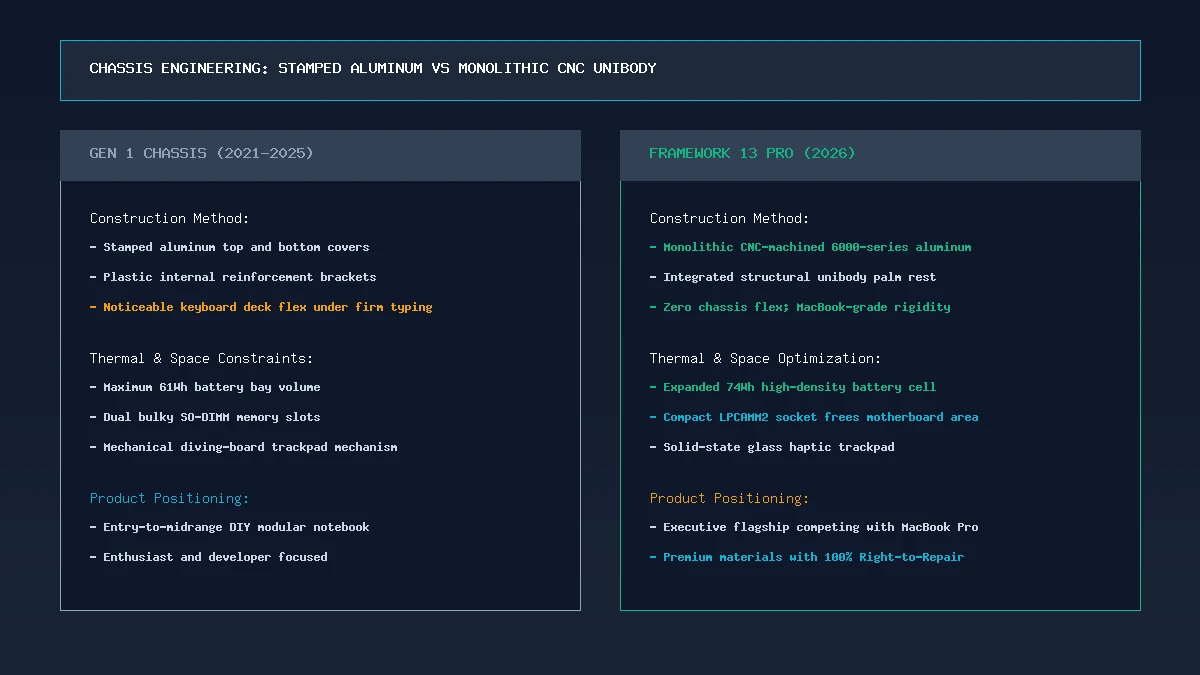
Chassis engineering: The transition to monolithic CNC-machined 6000-series aluminum eliminates keyboard deck flex while maintaining full internal access.
The original Framework 13 utilized stamped aluminum sheets reinforced with internal plastic structural ribs. While lightweight and eco-friendly, it exhibited noticeable keyboard deck flex under heavy typing and lid bounce when used on uneven surfaces. The Framework Laptop 13 Pro transitions entirely to precision CNC-machined 6000-series anodized aluminum.
By milling the top cover and palm rest enclosure from solid billets of aerospace-grade alloy, Framework achieved rigidity comparable to Apple’s unibody MacBooks and Dell’s XPS line. Key structural improvements include:
- Zero Deck Flex: The palm rests and keyboard tray remain completely motionless under high actuation pressure.
- Reinforced Display Hinges: Redesigned friction hinges eliminate screen wobble while preserving smooth one-finger lid opening.
- Magnetic Alignment Pins: Internal fastening brackets now feature micro-machined guide pins that ensure perfect component alignment during DIY reassembly.
The LPCAMM2 Revolution: High-Speed Modular Memory Explained
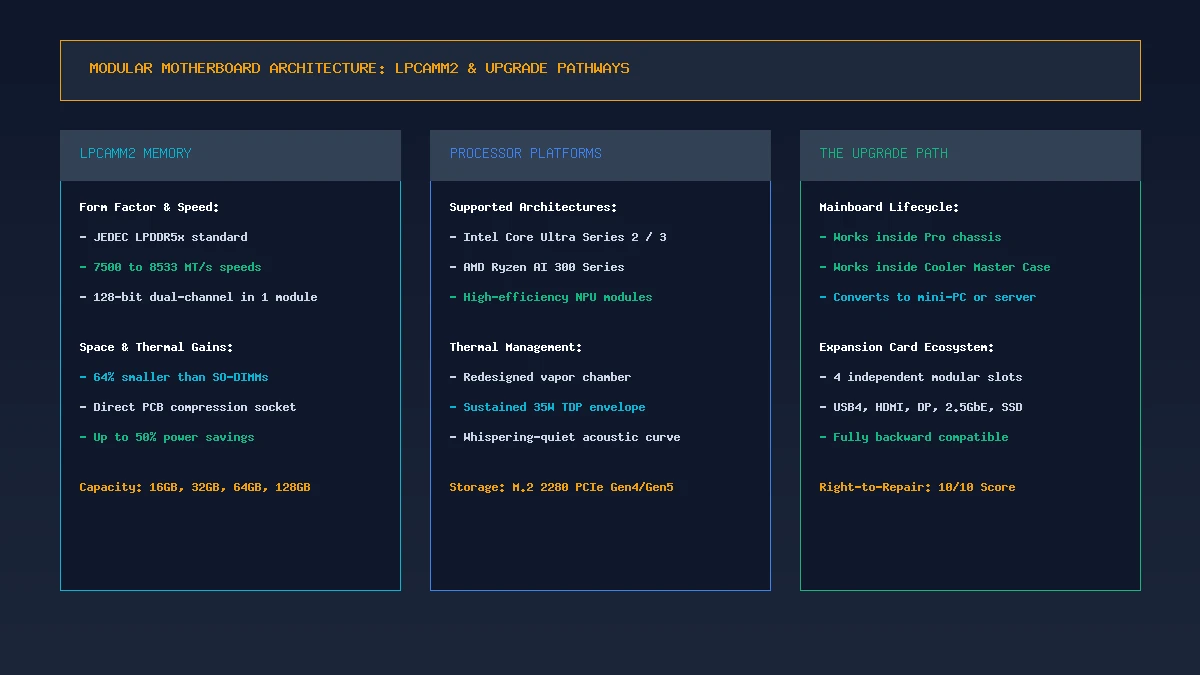
Modular memory evolution: LPCAMM2 delivers soldered-grade LPDDR5x speeds (up to 8533 MT/s) in a compact, user-swappable compression module.
The most consequential architectural innovation in the Framework 13 Pro is the adoption of LPCAMM2 (Low Power Compression Attached Memory Module). For years, the PC industry claimed that upgrading memory was incompatible with modern power efficiency and high data rates, forcing consumers into soldered RAM configurations.
LPCAMM2 disproves this narrative completely. Developed by JEDEC and industry memory leaders, LPCAMM2 mounts low-power LPDDR5x memory directly over a high-density compression socket. Key benefits realized in the Pro redesign include:
- Blistering Speed: Operates at transfer rates up to 8533 MT/s with a full 128-bit memory bus on a single module.
- Space Optimization: Occupies 64% less motherboard footprint and reduced vertical z-height compared to dual SO-DIMM slots, freeing critical internal volume for battery expansion.
- Power Efficiency: Delivers up to 50% energy reduction during memory-intensive tasks compared to standard DDR5 SO-DIMMs.
- User Upgradeability: Secured by just three captive screws, allowing users to upgrade from 16GB to 32GB, 64GB, or 128GB in under two minutes.
Display Evolution: 2.8K, 120Hz VRR, and 10-Point Touch Support
Framework laptops have consistently favored the productivity-friendly 3:2 aspect ratio, offering more vertical workspace than traditional 16:9 or 16:10 panels. The Pro redesign significantly elevates the visual standard:
- 2.8K Resolution (2880 × 1920): Sharp 256 PPI density that ensures smooth typography for developers, legal professionals, and writers.
- 120Hz Variable Refresh Rate: Dynamically adjusts refresh rates to balance buttery-smooth animations with battery conservation.
- 10-Point Capacitive Touchscreen: Adds intuitive gesture navigation and annotation support without adding excessive reflective glare, thanks to an anti-reflective matte coating.
- 500 Nits Brightness & Wide Color: Covers 100% sRGB and 98% DCI-P3 with wide viewing angles for color-critical photo editing.
Thermal Architecture and 74Wh Battery Engineering
Battery life was the single most requested improvement from the Framework community. The original Framework 13 launched with a 55Wh pack, later revised to 61Wh. In the Laptop 13 Pro, Framework completely redesigned the lower chassis cavity to house an immense 74Wh lithium-polymer battery.
Combined with the energy savings of LPCAMM2 memory and efficient next-gen silicon (Intel Core Ultra Series 2 / AMD Ryzen AI 300), the 74Wh battery delivers 14 to 16 hours of real-world productivity. Furthermore, Framework redesigned the thermal module with a wider vapor chamber and larger low-noise cooling fan, capable of dissipating a sustained 35W TDP while maintaining near-silent acoustic performance.
Input Advancements: Glass Haptic Trackpad & Physical Privacy Switches
The redesign replaces the mechanical diving-board trackpad with a solid-state seamless glass haptic trackpad. Using precision piezoelectric actuators, it delivers a uniform, tactile click anywhere on the surface without mechanical switches that can gather dust or fail over time.
For privacy-conscious users, the redesigned top bezel integrates an upgraded 1080p Full HD webcam alongside hardware-level physical cutoff switches that physically disconnect power to the camera sensor and dual stereo microphones.
The Backward Compatibility Balance: What Changes and What Stays
A central tenet of Framework’s philosophy is long-term sustainability. While the Pro model introduces a new chassis standard, Framework carefully preserved compatibility where it mattered most:
| Hardware Component | Compatibility Status | Notes & Details |
|---|---|---|
| Expansion Cards (Ports) | 100% Compatible | All USB-C, USB-A, HDMI, DP, MicroSD, 2.5GbE cards fit perfectly. |
| Storage & Wi-Fi | 100% Compatible | Standard M.2 2280 NVMe SSDs and M.2 2230 Wi-Fi 7 modules transfer over. |
| Mainboard Upgrades | Adapter Compatible | Framework offers mounting kits to install Pro mainboards into Gen 1 shells. |
| 74Wh Battery Pack | Pro Chassis Exclusive | Requires the deeper internal battery bay of the Pro CNC lower enclosure. |
| System Memory (RAM) | LPCAMM2 Exclusive | Pro mainboards utilize LPCAMM2 and cannot accept older SO-DIMM sticks. |
Generational Comparison: Framework 13 (Gen 1) vs Framework 13 Pro
| Feature | Original Framework 13 (Gen 1) | Framework Laptop 13 Pro (2026) |
|---|---|---|
| Chassis Construction | Stamped Aluminum with plastic bracketry | Monolithic CNC Machined Aluminum |
| Memory Architecture | Dual SO-DIMM (DDR4 / DDR5) | Modular LPCAMM2 (LPDDR5x up to 8533 MT/s) |
| Display Panel | 13.5″ 2256 × 1504 (60Hz, Non-Touch) | 13.5″ 2880 × 1920 (120Hz VRR, 10-Pt Touch) |
| Battery Capacity | 55Wh / 61Wh (7–9 Hours Runtime) | 74Wh (+60% capacity; 14–16 Hours Runtime) |
| Trackpad Technology | Mechanical Diving-Board Hinge | Solid-State Glass Haptic Actuator |
| Target Market / Price | Accessible Modular DIY ($899–$1,049) | Executive Flagship Modular ($1,399–$1,599) |
The Right-to-Repair Blueprint for the Next Decade
The Framework Laptop 13 Pro redesign proves that modularity and repairability do not require compromising on industrial design, battery runtime, or display quality. By successfully integrating LPCAMM2 memory and CNC machining, Framework has established a blueprint for the entire computing industry.
Furthermore, Framework’s secondary lifecycle ecosystem ensures retired mainboards don’t end up in landfills. Users who eventually upgrade their Pro mainboard can place the older board into a $39 standalone Cooler Master case, repurposing it as a home server, media center, or developer compile node.
Pros and Cons of the Redesign
Key Strengths:
- Class-Leading 74Wh Battery: Delivers 14 to 16 hours of continuous real-world endurance.
- Modular LPCAMM2 LPDDR5x Memory: Combines soldered-level speeds with 100% user-upgradeable RAM.
- Precision CNC Aluminum Enclosure: Eliminates keyboard deck flex and provides luxury fit and finish.
- Stunning 2.8K 120Hz 3:2 Touchscreen: Unbeatable aspect ratio for software engineering and productivity.
- 100% Expansion Card Continuity: Existing modular USB-C, HDMI, and storage cards carry over flawlessly.
Key Trade-Offs:
- Higher Base Price: Pricing now targets the premium flagship bracket ($1,399+).
- Chassis Backward Incompatibility: Older Gen 1 bottom cases cannot fit the 74Wh battery or Pro mainboard without adapters.
Verdict on the Framework Laptop 13 Pro Redesign
The Framework Laptop 13 Pro redesign is a monumental achievement in personal computing. By resolving the battery life and build-quality compromises of earlier generations, Framework has elevated the modular laptop from a niche enthusiast project to one of the most compelling, future-proof executive ultraportables on the market.
For professionals, developers, and sustainability advocates seeking an uncompromised premium notebook built to last a decade, the Framework Laptop 13 Pro sets the gold standard for modern hardware design.
Frequently Asked Questions
What are the biggest changes in the Framework Laptop 13 Pro redesign?
The major upgrades include a monolithic CNC-machined aluminum chassis, a 74Wh battery (+60% capacity), modular LPCAMM2 LPDDR5x memory, a 13.5-inch 2.8K 120Hz 3:2 touchscreen display, and a glass haptic trackpad.
Why did Framework switch to LPCAMM2 memory?
LPCAMM2 allows the laptop to use ultra-fast LPDDR5x RAM (up to 8533 MT/s) with 50% lower power draw and 64% smaller motherboard space than SO-DIMM slots, while keeping the memory completely modular and user-upgradeable.
Can I put the 74Wh battery into an original Framework 13 chassis?
No. The 74Wh battery requires the redesigned interior layout and deeper cavity of the Framework 13 Pro CNC lower enclosure, making it incompatible with Gen 1 bottom covers.
Do existing Framework expansion cards work on the Pro model?
Yes. All original expansion cards—including USB-C, USB-A, HDMI, DisplayPort, MicroSD, Ethernet, and secondary SSD cards—remain 100% compatible with the Framework 13 Pro.
How much does the Framework Laptop 13 Pro cost?
The DIY Edition starts at $1,399, while pre-built, fully configured models with Windows 11 start at $1,599.
Does the Framework Laptop 13 Pro support Linux?
Yes. Framework officially validates and provides tier-1 driver support for Ubuntu LTS, Fedora Workstation, and other major Linux distributions out of the box.