
AI public trust is not rising at the same speed as artificial intelligence capability. People may use AI features every day while remaining uneasy about how systems collect data, replace work, generate misinformation, and make decisions that are difficult to challenge.
That gap matters because adoption does not automatically create acceptance. This article examines current public opinion on artificial intelligence, the practical reasons behind consumer skepticism about AI, and the steps companies, governments, and product teams can take to build trust without relying on vague promises.
Table of Contents
What AI Public Trust Really Means
AI public trust is the expectation that an artificial intelligence system will behave acceptably, disclose its limitations, protect people from avoidable harm, and provide a meaningful way to correct mistakes. It is broader than whether a person likes a chatbot or finds an automated feature convenient.
Trust also depends on who controls the system and who bears the consequences when it fails. A person might tolerate an incorrect restaurant recommendation but reject an opaque system that affects a loan application, employment opportunity, medical decision, insurance claim, or access to public services.
For that reason, trust is not a single opinion that can be measured with one question. It includes several related judgments:
- Capability: Does the system usually perform the task well?
- Reliability: Does it behave consistently across similar situations?
- Safety: Does it reduce foreseeable risks, including privacy and security risks?
- Transparency: Can people understand when and how AI is being used?
- Accountability: Is a responsible person or organization available when something goes wrong?
- Fairness: Does the system avoid imposing disproportionate harm on particular groups?
- Agency: Can people review, appeal, opt out of, or override an automated decision where appropriate?
A company can therefore produce a technically impressive model and still lose public confidence. If the product makes surprising decisions, hides data practices, or treats human review as an afterthought, users may judge it as untrustworthy even when its average accuracy looks strong.
What Research Says About Public Opinion on Artificial Intelligence
Recent polling does not show a simple public split between people who love AI and people who reject it. Views vary by use case, age, education, familiarity, perceived benefits, and the personal risks attached to a decision. People often express interest in helpful applications while opposing uses that affect jobs, privacy, elections, or human judgment.
For example, a Pew Research Center report on young adults’ concerns about AI and employment illustrates why economic security remains central to public opinion. Concern about job displacement is not merely a reaction to technical errors; it reflects uncertainty about who will benefit from productivity gains and who will absorb the costs.
A separate YouGov survey on the pace of AI development and optimism points to another part of the problem: some people believe development is moving faster than institutions, workplaces, and communities can manage. That perception can turn each new product announcement into evidence that the industry is setting the timetable without sufficient public consent.
These findings should not be interpreted as proof that consumers oppose all AI. They suggest a more useful conclusion: acceptance is conditional. People want visible benefits, understandable safeguards, and evidence that companies will remain accountable after deployment.
| AI situation | What may encourage confidence | What may reduce confidence |
|---|---|---|
| Personal productivity assistant | Clear data controls, editable outputs, easy human review | Training on private content without clear consent, confident errors |
| Customer-service automation | Fast escalation to a person, accurate answers, clear disclosure | Endless automated loops, hidden automation, no meaningful appeal |
| Hiring or screening tool | Independent evaluation, job-relevant criteria, human oversight | Opaque scoring, unexplained rejection, historical bias |
| Medical decision support | Clinical validation, qualified supervision, documented limitations | Unverified recommendations, unclear responsibility, missing patient context |
| Generative media tool | Provenance information, consent protections, abuse reporting | Impersonation, unmarked synthetic content, copyright disputes |
The pattern is consistent: trust tends to be specific rather than universal. Asking whether people “trust AI” produces a less useful answer than asking which system they trust, for what task, under whose control, and with what remedy when it fails.
Why People Distrust AI
The question “why people distrust AI” has several answers, and they reinforce one another. Some concerns come from direct experiences with inaccurate or intrusive tools. Others arise from broader fears about labor markets, institutional power, and the possibility that synthetic content will make it harder to determine what is real.
Accuracy Without Accountability
Generative systems can produce fluent answers that contain factual errors. The language may sound authoritative even when the underlying response is incomplete, outdated, or invented. This creates a trust problem that ordinary software bugs do not always create: the system can make a mistake while appearing certain.
Accuracy alone is not enough. Users also need to know what the system did, what sources or records informed the result, how confident they should be, and how to report or correct an error. Without those signals, a polished interface can encourage overreliance.
Privacy and Data Use
People often cannot tell what information an AI product stores, whether prompts are used to improve a model, how long records are retained, or which vendors receive the data. Long privacy policies rarely resolve that uncertainty when the product experience does not explain the practical choices in plain language.
Privacy concerns become sharper when an AI system processes workplace documents, conversations, health information, children’s data, biometric information, or detailed behavioral histories. Even a useful feature may lose support if users believe participation requires surrendering information they cannot later retrieve or delete.
Jobs and Economic Security
Many workers are not evaluating AI as an abstract invention. They are evaluating a technology that may change their wages, responsibilities, career path, or bargaining power. Employers that describe automation only as efficiency can sound as if the human effects are someone else’s problem.
People may accept tools that remove repetitive tasks while resisting systems introduced to monitor performance, reduce staffing, or impose productivity targets without consultation. The difference is not simply technical capability; it is whether workers have voice, training, and a fair share of the benefits.
Bias and Unfair Treatment
AI systems learn from data and operate within institutions that may already contain unequal outcomes. A model can reproduce those patterns, amplify them, or make them harder to detect because its reasoning is hidden behind a score or recommendation.
Claims that an algorithm is “objective” can worsen consumer skepticism about AI. People are more likely to trust a system when its limitations are acknowledged, its performance is evaluated across relevant groups, and affected individuals have a route to challenge a decision.
Misinformation and the Loss of Authenticity
Generative AI makes it cheaper to create realistic text, images, audio, and video. That can support accessibility, education, and creative work, but it also complicates elections, journalism, customer communications, and personal relationships.
The concern is not limited to a single fake image or fraudulent voice call. If people begin to doubt genuine evidence by default, institutions and individuals face a broader credibility problem. Companies that release powerful generation tools therefore influence artificial intelligence public perception through their decisions about labeling, provenance, abuse response, and access.
AI Adoption Versus Acceptance
AI adoption versus acceptance is one of the most important distinctions in the debate. A person may use an AI search feature because it is built into a service they already need, while still opposing the company’s data practices or worrying about the tool’s social effects.
Usage can also be coerced or difficult to avoid. An employee may be required to use an AI writing system. A customer may encounter a chatbot before reaching a human agent. A student may use an automated tool because classmates and employers expect familiarity with it.
That means usage statistics should not be treated as a direct measure of public confidence. A more complete assessment asks:
- Did people choose the AI feature or encounter it by default?
- Did they understand that AI was involved?
- Could they refuse without losing essential access?
- Did the tool perform the task accurately enough?
- Could a person review the result?
- Would users recommend the feature for a similar high-stakes task?
- Did the organization respond fairly when the system made a mistake?
This distinction also explains why a product can have high engagement and low goodwill. Convenience drives repeated use, but trust determines whether people support wider deployment, share sensitive information, or accept AI in more consequential settings.
Where AI Backlash Comes From
AI backlash rarely comes from one viral incident alone. It usually builds when several frustrations converge: unclear product changes, aggressive marketing, job anxiety, poor customer support, disputed training data, and a sense that companies are asking society to accept risks before explaining who is responsible.
Public resistance can grow when organizations call a system “assistive” even though it makes decisions or sets constraints that people cannot meaningfully override. The language creates a mismatch between the product’s real power and the user’s expectations.
Backlash also becomes more likely when companies present criticism as ignorance or fear of innovation. Consumers do not need to understand model architecture to identify an unfair charge, a fabricated answer, or a lost job opportunity. Dismissing those experiences damages credibility.
Infrastructure can influence sentiment as well. The expansion of data centers and the electricity, water, land, and grid capacity they require can make AI feel like a local policy issue rather than a distant software trend. Communities may support useful technology while asking whether the economic and environmental trade-offs are being distributed fairly.
Industry leaders sometimes argue that better models will resolve public doubts. Better performance helps, but it cannot answer every governance question. A more capable system can produce more persuasive misinformation, automate more sensitive decisions, or scale a harmful process more efficiently if the surrounding controls remain weak.
How to Build Trust in AI
Learning how to build trust in AI starts with changing the product and the institution around it, not simply changing the advertising. Trust grows when users can observe responsible behavior over time.
Disclose AI Use at the Right Moment
Disclosure should appear where it affects a user’s decision. A small notice buried in terms of service is inadequate if an automated system is evaluating an application, summarizing a medical record, or responding to a complaint.
Useful disclosure answers three questions:
- Where is AI being used?
- What can the system do, and what can it not do reliably?
- What human review or escalation options are available?
The goal is not to overwhelm people with technical detail. It is to give them enough context to calibrate their reliance and decide whether to continue.
Give Users Practical Data Control
Privacy controls should be understandable and usable. A responsible product should explain whether prompts or uploaded files are retained, whether they may be used for model improvement, who can access them, and how a person can delete or export relevant data.
Default settings matter. If the safest option is hidden, difficult to find, or available only to technical users, the organization is effectively shifting the burden of privacy protection onto the public.
Design for Human Review
Human oversight should be more than a name on an organizational chart. Reviewers need authority, time, relevant information, and a process for correcting both the AI output and the underlying workflow.
For high-impact uses, people should know how to request a review and what information will be considered. An appeal mechanism that automatically repeats the original model’s recommendation does not provide meaningful accountability.
Test Before and After Launch
Pre-release testing should examine accuracy, security, privacy, accessibility, and unequal performance across relevant situations. After launch, teams should monitor real-world errors, complaints, workarounds, and unexpected uses.
The NIST AI Risk Management Framework offers a widely used structure for thinking about AI risks through governance, mapping, measurement, and management. It is not a guarantee of safety, but it helps organizations turn broad principles into repeatable risk practices.
Make Claims That Match the Evidence
Marketing creates expectations that engineering and support teams must later meet. Claims such as “understands,” “eliminates bias,” or “replaces experts” can mislead when the evidence supports only a narrower statement.
The Federal Trade Commission’s guidance on keeping AI claims in check is a useful reminder that companies need evidence for performance and benefit claims. Honest limits may slow a sale, but exaggerated promises can turn one failure into a much larger trust crisis.
A Practical Trust Framework for Companies
Organizations can evaluate AI public trust with a simple decision process before launching or expanding a system. The framework below is deliberately practical: it focuses on the experience of affected people rather than on model sophistication alone.
- Define the actual decision. State what the AI will influence, recommend, generate, or automate. Avoid describing a consequential decision as a minor “feature.”
- Identify affected groups. Include direct users, employees, customers, people represented in the data, and anyone who may bear indirect consequences.
- List plausible failure modes. Consider incorrect outputs, privacy leakage, discrimination, prompt abuse, fraud, overreliance, and failures during unusual conditions.
- Set a human responsibility point. Name the team or person accountable for monitoring, correction, and communication.
- Choose a safe default. When uncertainty is high, the system should pause, ask for clarification, limit the action, or route the case to a qualified human.
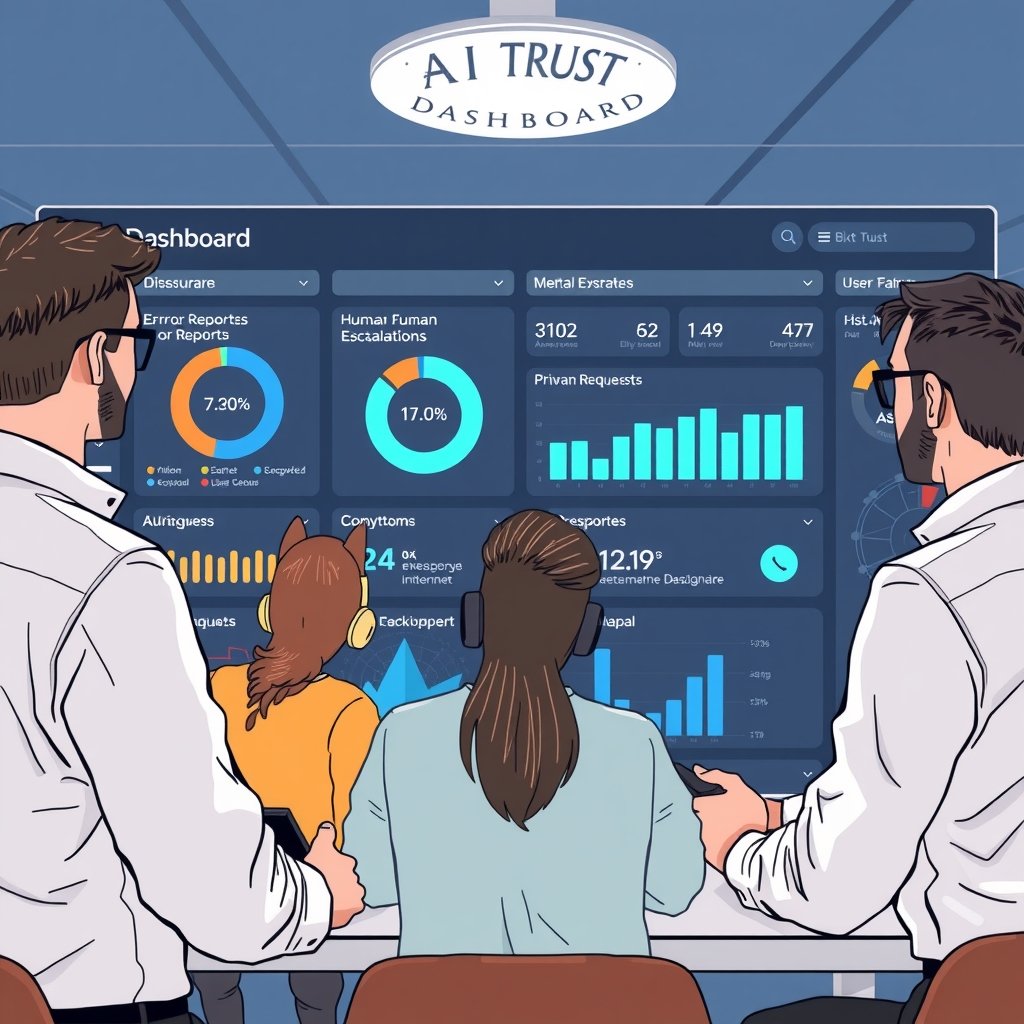
- Measure outcomes, not just activity. Track error rates, appeal outcomes, complaint themes, opt-outs, escalation quality, and whether the tool actually helps users.
- Publish meaningful changes. Explain material updates to capabilities, data practices, limitations, and user controls.
This framework can also help consumers and procurement teams compare products. A vendor that answers difficult questions clearly may be a safer choice than one that offers the most impressive demonstration but cannot explain retention, oversight, or redress.
Who Should Use AI and Who Should Wait?
AI can be appropriate when the task is low risk, the output is easy to check, and a person remains in control. Examples include brainstorming, formatting, transcription with review, accessibility assistance, summarizing familiar material, and generating first drafts that a qualified person verifies.
Extra caution is warranted when the system handles sensitive data, affects legal rights, determines access to essential services, or produces an output that ordinary users cannot evaluate. In those situations, organizations should consider a narrower deployment, stronger testing, independent review, or postponement until safeguards are credible.
Consumers should avoid treating fluent output as verified expertise. For health, legal, financial, employment, safety, and emergency decisions, AI can support questions and preparation but should not replace qualified professional judgment or official information.
Why Trust Will Determine the Next Stage of AI
The next phase of AI adoption will depend less on whether systems can produce impressive demonstrations and more on whether institutions can make them dependable in ordinary settings. People judge technology through customer support, workplace policy, billing disputes, privacy incidents, and the consequences of errors.
That is why consumer trust in AI is partly a governance issue. A model may be developed by one company, integrated by another, deployed by an employer, and experienced by a customer who has no direct relationship with the model provider. Responsibility must remain visible across that chain.
Trust is also cumulative. A transparent correction can strengthen confidence after a small failure. A defensive response, hidden policy change, or refusal to explain a high-impact decision can undermine confidence far beyond the original incident.
Companies should therefore treat public feedback as operational evidence rather than as a public-relations obstacle. Repeated complaints about confusing disclosure, inaccessible appeals, or inaccurate outputs indicate a product problem even when usage remains high.
Key Takeaways
- AI public trust is about reliability, safety, transparency, accountability, fairness, and user control—not just technical performance.
- Public opinion on artificial intelligence is conditional. People may welcome convenient tools while opposing high-risk or opaque uses.
- AI adoption versus acceptance matters: repeated use can reflect convenience, workplace requirements, or a lack of alternatives rather than genuine confidence.
- Why people distrust AI includes inaccurate outputs, unclear data practices, job insecurity, bias, misinformation, and weak appeal processes.
- AI backlash grows when companies overpromise, conceal limitations, dismiss criticism, or shift the cost of failures onto users and workers.
- To build trust in AI, organizations should disclose its use clearly, provide real data controls, test for unequal harms, support human review, and publish evidence that matches marketing claims.
- High-stakes applications need stronger safeguards than low-risk drafting, accessibility, or productivity tools.
Frequently Asked Questions
What is AI public trust?
AI public trust is the confidence that an artificial intelligence system and the organization deploying it will behave reliably, protect people from foreseeable harm, explain relevant limitations, and provide accountability when something goes wrong. It includes trust in the technology, the company, the rules governing its use, and the human processes around it. A person may trust one AI application while rejecting another because the risks and safeguards differ.
Why do people distrust AI?
Why people distrust AI varies by context, but common concerns include inaccurate or fabricated answers, invasive data collection, job displacement, algorithmic bias, synthetic misinformation, surveillance, and the absence of meaningful human support. Distrust increases when companies use broad marketing claims, hide important limitations, or make it difficult to challenge an automated decision. Familiarity may improve comfort, but it does not remove concerns about control and accountability.
Does high AI usage mean consumers trust AI?
No. Usage can reflect convenience, workplace requirements, default settings, or the absence of a human alternative. Someone may use an AI chatbot for a quick draft while refusing to rely on AI for a medical, employment, financial, or legal decision. Researchers and companies should distinguish active support from reluctant or unavoidable use when assessing consumer trust in AI.
What is the difference between AI adoption and AI acceptance?
AI adoption measures whether people or organizations use a system. AI acceptance is broader: it indicates whether they consider the system legitimate, beneficial, fair, and appropriate for its purpose. Adoption can happen without acceptance when users have limited choices. Acceptance is more likely when people understand the system, see clear benefits, retain control, and believe there is a fair remedy for mistakes.
How can companies build trust in AI?
Companies can build trust in AI by making disclosures easy to see, explaining data retention and training practices, testing for accuracy and unequal outcomes, providing human escalation, and correcting errors publicly and promptly. They should also match performance claims to evidence and avoid presenting a general-purpose model as an authority in a specialized field. Trust improves when responsible behavior is built into product design, support, procurement, and governance rather than added after a controversy.
Can regulation improve AI public trust?
Clear regulation can improve confidence by setting consistent expectations for privacy, safety, transparency, and accountability. However, regulation alone cannot create trust if organizations technically comply while making systems confusing or difficult to challenge. Effective rules work alongside independent testing, strong internal governance, user education, and accessible remedies. Public trust depends on whether people experience those protections in practice.
Conclusion
The central lesson from AI public trust research and public reaction is that impressive capability does not automatically win people over. Consumers are judging whether AI delivers dependable benefits without taking away privacy, agency, economic security, or the ability to obtain a human explanation.
Organizations that want broader acceptance should begin with one concrete system rather than a sweeping promise about artificial intelligence. Document its risks, disclose its role, measure real-world outcomes, give affected people a meaningful appeal route, and publish what changes after problems appear. That practical evidence is more likely to earn trust than another claim that AI is ready to transform everything.