
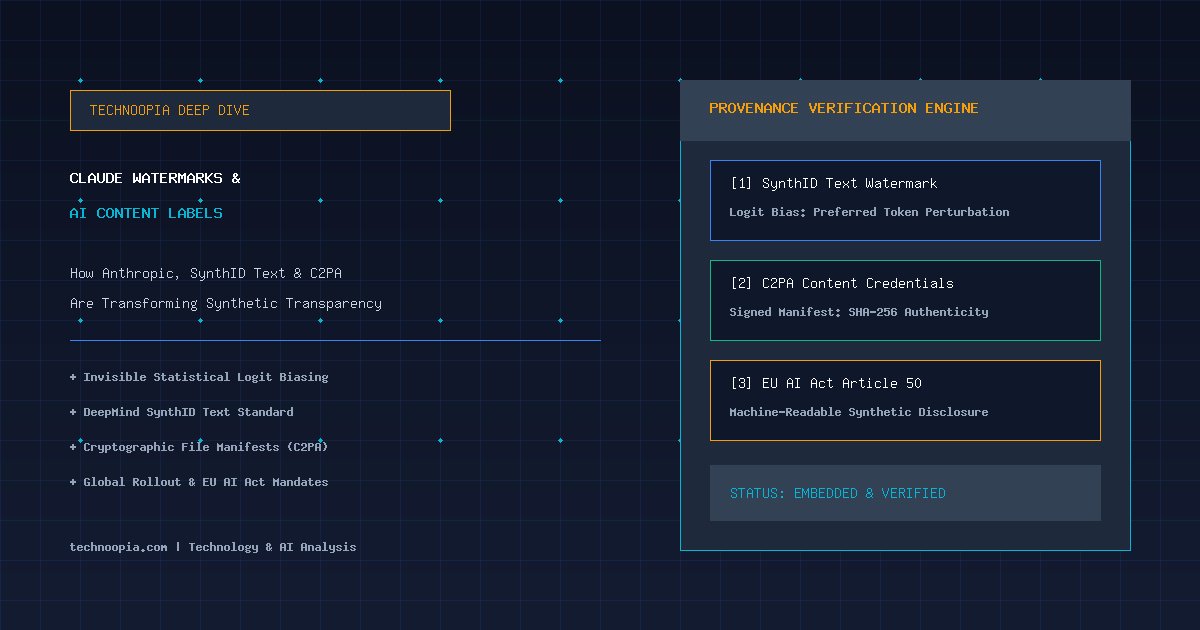
The quiet rollout of Claude watermarks across Anthropic’s ecosystem marks one of the most consequential milestones in the history of generative artificial intelligence. For years, identifying whether a passage of prose was drafted by a human or generated by a large language model felt like an intractable guessing game governed by unreliable third-party software. That ambiguity is now ending. By embedding imperceptible mathematical signatures directly into generated sentences and attaching cryptographic provenance data to exported files, Anthropic has turned synthetic transparency into an active model feature rather than an afterthought.
This development is not an isolated technical experiment. It represents the vanguard of a broader structural shift across the technology sector. Driven by stringent global mandates—most notably the European Union’s AI Act—and escalating public anxiety over synthetic media, Big Tech companies are being pushed to establish clear, verifiable boundaries between human-generated content and machine-generated outputs. Yet, as with any foundational infrastructure change, the arrival of invisible watermarking has ignited intense debate among writers, software engineers, educators, and enterprise leaders who wonder what these signals mean for digital privacy, creative ownership, and the future of online publishing.
Table of Contents
- What Are Claude Watermarks?
- Why Anthropic Is Watermarking Claude-Generated Content
- How Claude’s Invisible Text Watermark Works
- What Is SynthID Text? DeepMind’s Open-Source Foundation
- What Happens to Images and Files? Understanding C2PA Metadata
- The EU AI Act Connection: Global Regulation in Action
- Why AI Labels Are Becoming a Big Tech Responsibility
- Why Some Claude Users Don’t Like Watermarking
- Does Claude Watermarking Reduce Writing Quality?
- Can Claude Watermarks Survive Editing or Copying?
- Claude Watermark vs AI Detector: Crucial Differences
- Claude vs Gemini vs ChatGPT: How Platforms Compare
- What Claude Watermarks Mean for Writers and Bloggers
- What It Means for Students and Educators
- What It Means for Businesses and Developers
- Are AI Labels Actually Enough to Protect Online Trust?
- What Happens Next in Content Transparency?
- Final Verdict
- Frequently Asked Questions
What Are Claude Watermarks?
Quick Summary: Claude watermarks are imperceptible, machine-readable signals embedded directly into text and files produced by Anthropic’s Claude AI models. In text, they alter token probability selections into statistical patterns detectable by specialized algorithms. In files and images, they attach cryptographically signed C2PA provenance metadata to verify origin without changing appearance or prose quality.
In plain terms, Claude watermarks are technical mechanisms designed to prove that a piece of digital material originated from Anthropic’s AI systems. Unlike traditional watermarks—such as a semi-transparent logo stamped over a stock photo or a visible footer at the bottom of a PDF—Claude’s markings are completely invisible to the human eye.
When you interact with Claude to write an essay, summarize a research document, write code, or produce a diagram, the output appears completely natural. There are no hidden Unicode characters, zero-width spaces, or secret punctuation tricks inserted into the sentences. Instead, the text contains a subtle mathematical bias in word choice that can be verified using statistical analysis tools. For structured media like images or vector charts, Claude attaches cryptographically signed metadata manifests that record the file’s synthetic origin.
Anthropic has implemented these capabilities across its entire product lineup—including the web interface at Claude.ai, the Claude API, Claude Code, and enterprise workspaces—applying them systematically to modern model releases.
Why Anthropic Is Watermarking Claude-Generated Content
The decision to deploy watermarking at scale is not merely a technical demonstration; it is a response to compounding regulatory, ethical, and market pressures. As artificial intelligence models have become capable of producing human-grade prose, distinguishing between authentic human expression and automated output has become essential for preserving AI public trust.
Anthropic’s rationale rests on three primary pillars:
- Regulatory Compliance: Legal frameworks around the globe, most prominently in Europe, now mandate that providers of high-capability AI systems provide machine-readable disclosures for synthetic media.
- Mitigating Misinformation and Impersonation: Transparent provenance makes it substantially more difficult for bad actors to mass-produce deceptive news articles, fraudulent product reviews, or automated propaganda campaigns without leaving a verifiable signature.
- Industry Leadership in Responsible AI: By adopting open standards for provenance and watermarking, Anthropic aims to establish a benchmark for corporate responsibility that balances user utility with public accountability.
Rather than waiting for fragmented national regulations to emerge, Anthropic chose to apply these transparency measures globally. This universal rollout ensures that developers and end-users encounter consistent behavior regardless of their geographical location.
How Claude’s Invisible Text Watermark Works
To grasp how a text watermark can exist without being seen, one must understand how large language models generate language. When an LLM produces a response, it does not write full sentences simultaneously. Instead, it generates text sequentially, one token (a word, subword, or punctuation mark) at a time.
Token Probabilities and Pseudo-Random Selection
At each step of generation, the model evaluates its entire vocabulary and calculates a probability distribution for the next likely token. In a standard generation pass, several words might make equal sense in a given sentence:
“The scientist conducted an extraordinary [experiment / study / trial / investigation].”
Under standard sampling, the model selects one of these high-probability candidates at random, weighted by their respective likelihood scores. Text watermarking introduces a deliberate, mathematical rule into this selection process.
Using a cryptographic pseudo-random number generator initialized by the preceding words (the context window), the watermarking algorithm splits the vocabulary into designated groups—often conceptualized as “green” and “red” lists. The model then applies a gentle mathematical bonus (a logit bias) to valid candidate words that appear on the preferred list.
Crucially, this bias is only applied among tokens that already possess high contextual relevance. The model never selects an awkward, ungrammatical, or nonsensical word simply because it carries a watermark flag. To a human reader, the phrasing remains flawless and indistinguishable from unwatermarked writing.
Statistical Detection Without Visible Keys
When an authorized detector analyzes a passage of text, it does not look for specific hidden characters. Instead, it recalculates the expected token lists across the sequence of words. If the text was written by a human, the distribution of chosen words will match normal linguistic probability—falling on the preferred lists roughly half the time by pure chance.
However, if the text was generated with Claude watermarks, the frequency of preferred tokens will skew significantly higher than random probability would ever dictate. Over a passage of 150 to 300 words, this statistical skew accumulates into mathematical certainty, allowing the detector to confirm synthetic generation with an exceptionally low rate of false positives.
What Is SynthID Text? DeepMind’s Open-Source Foundation
Anthropic did not build its text watermarking architecture in isolation. Claude utilizes a production implementation derived from SynthID Text, the pioneering watermarking technology developed by Google DeepMind and released as an open-source tool for the broader AI research community.
Google DeepMind originally introduced SynthID to address media provenance across audio, images, and video before extending the mathematics to discrete token sequences in large language models. The breakthrough of SynthID Text lies in its preservation of output quality and computational efficiency. Unlike earlier academic watermarking proposals that noticeably degraded a model’s reasoning ability or inflated API latency, SynthID Text integrates directly into the model’s logits processing layer with negligible overhead.
By leveraging an open, peer-reviewed mathematical framework, Anthropic aligns its platform with an emerging industry standard rather than deploying a proprietary, black-box technique that third-party systems could never interoperate with.
What Happens to Images and Files? Understanding C2PA Metadata
While continuous natural text requires statistical watermarking, binary files—such as digital images, vector graphics (.svg), audio files, and exported documents—rely on a fundamentally different standard known as C2PA metadata.
The Coalition for Content Provenance and Authenticity (C2PA) is an international standards body founded by technology and media leaders including Adobe, Microsoft, Google, Intel, and the BBC. C2PA establishes a secure method for embedding cryptographic provenance manifests directly into file headers.
When Claude generates or exports a supported file, it attaches a tamper-evident digital signature containing vital provenance records:
- The software and model version that created or edited the asset (e.g., Claude 3.5 Sonnet).
- The exact timestamp of creation.
- The cryptographic certificate verifying that the manifest was issued by Anthropic’s verified signing authority.
- An audit trail recording any subsequent transformations or edits applied by compliant software.
If an individual attempts to alter the file’s metadata manually or manipulate the underlying pixels, the cryptographic hash breaks immediately, alerting verification tools that the file’s provenance manifest has been invalidated.
The EU AI Act Connection: Global Regulation in Action
The timing of Anthropic’s deployment is directly linked to the enforcement schedule of the European Union Artificial Intelligence Act (EU AI Act), which entered into force in mid-2024 with progressive compliance deadlines extending through 2026.
Under Article 50 of the EU AI Act, providers of generative AI systems face strict transparency obligations. Specifically, providers must ensure that:
- Synthetic audio, image, video, or text content is marked in a machine-readable format.
- Outputs are detectable as artificially generated or manipulated.
- Technical solutions are effective, robust, and state-of-the-art while taking into account the specific characteristics of different content formats.
Because the penalties for non-compliance under the EU AI Act can reach tens of millions of euros or up to 7% of global annual turnover, major frontier AI labs cannot treat transparency as optional. Furthermore, because software architectures are globally distributed, maintaining separate model weights for European users and rest-of-world users would introduce immense engineering complexity and security liabilities. Consequently, EU regulatory milestones have become the de facto global baseline for AI disclosure.
Why AI Labels Are Becoming a Big Tech Responsibility
Beyond regulatory compulsion, the push toward mandatory AI labels reflects an evolving consensus on the societal responsibilities of foundational model developers. In the early phases of the generative AI boom, the burden of detecting automated content was pushed entirely onto end-users, educators, and third-party software developers.
That paradigm proved unsustainable. The rapid proliferation of automated content farms, AI-driven social botnets, synthetic financial scams, and deepfakes exposed severe vulnerabilities in our digital ecosystem. Today, digital platforms and model providers recognize that maintaining online trust requires active collaboration across the entire content lifecycle.
When frontier AI labs embed watermarks and provenance data at generation time, search engines, social networks, news publishers, and academic institutions can verify content authenticity automatically. This shared verification layer protects consumers while preserving the open web from being overwhelmed by unverified synthetic noise.
Why Some Claude Users Don’t Like Watermarking
Despite the clear public-interest arguments in favor of transparency, the arrival of Claude AI watermarks has generated substantial apprehension among everyday users and professionals. These concerns stem from legitimate questions regarding privacy, workflow friction, and the potential misuse of detection signals.
1. Fears of Unfair Academic Penalization
Students and academic researchers express widespread concern that watermarking will exacerbate existing tensions around AI detection in schools and universities. If an educator runs an essay through a detection tool that flags a mathematical watermark, students worry they could face severe disciplinary action even if they only used Claude for preliminary brainstorming, grammar checking, or outlining.
2. Anxiety Over Creative and Professional Attribution
Freelance copywriters, ghostwriters, translators, and marketing agencies often utilize AI tools to assist their creative process. Many fear that clients will interpret the presence of a watermark as proof that an entire project was generated automatically without human thought or skill, devaluing professional labor and leading to billing disputes.
3. Misunderstandings Regarding User Tracking and Privacy
Some users mistakenly believe that watermarks contain personal identifiers—such as their user account ID, IP address, prompt history, or organization name. While Anthropic has clarified that text watermarks contain only general statistical signals indicating model generation rather than personal user data, the technical obscurity of the system leaves room for lingering privacy doubts.
4. Asymmetry Across the AI Industry
Developers who rely on Claude for commercial software note that as long as open-weight models (such as Meta’s Llama series) or competing proprietary models operate without watermarks, platforms that strictly enforce watermarking may place their users at a competitive disadvantage in markets where automated output remains undisclosed.
Does Claude Watermarking Reduce Writing Quality?
One of the most persistent concerns surrounding watermarked text is whether perturbing token probabilities harms the intelligence, nuance, or creativity of the output. In the early days of NLP research, rudimentary watermarking algorithms frequently caused models to generate repetitive phrasing, disjointed syntax, or outright factual errors because the system was forced to select sub-optimal tokens.
With modern implementations like SynthID Text, comprehensive empirical evaluations indicate that writing quality remains statistically indistinguishable from unwatermarked generations.
Research published by Google DeepMind and corroborated across large-scale blind human evaluations demonstrates that when the perturbation bias is calibrated carefully:
- Perplexity and Fluency: The statistical measure of text naturalness (perplexity) shows no meaningful degradation across standard benchmarks.
- Factuality and Mathematical Reasoning: Because watermarking biases are only applied across interchangeable synonyms and stylistic tokens, the model does not alter mathematical equations, programming code syntax, or factual entities where only a single token is correct.
- Blind Preference Testing: Human raters fail to identify watermarked text over unwatermarked text at rates higher than a random coin flip.
Nevertheless, in highly constrained tasks—such as ultra-concise code generation, rigid tabular outputs, or highly specific rhyming poetry—overzealous watermarking can theoretically narrow the model’s expressive range. Anthropic’s deployment dynamically adjusts watermarking intensity to prevent degradation in deterministic tasks.
Can Claude Watermarks Survive Editing or Copying?
A frequent question among content creators is how durable Claude watermarks are when text is modified, reformatted, or integrated into broader documents. Because the watermark is a distributed statistical signal embedded across many words rather than a single digital tag, its resilience depends entirely on the degree of transformation.
Copying and Direct Pasting
If a user copies a passage generated by Claude and pastes it directly into a blog post, email, or word processor, the statistical watermark remains 100% intact. Because the words and their sequential relationships are unaltered, any authorized detection tool can analyze the text and verify its origin.
Light to Moderate Editing
Correcting typos, restructuring a few sentences, changing punctuation, or swapping out occasional adjectives will weaken the statistical signal slightly, but it rarely eliminates it. In a 500-word article, even if 20% to 30% of the words are edited by hand, the remaining statistical bias across the surrounding text often provides sufficient statistical confidence for detection.
Heavy Paraphrasing and Rewriting
When text undergoes comprehensive human rewriting—such as completely restructuring paragraphs, summarizing key arguments in new words, or translating the text into another language—the underlying token sequence is destroyed. In these scenarios, the watermark degrades below the threshold of statistical significance, and the text can no longer be reliably identified as synthetic.
Claude Watermark vs AI Detector: Crucial Differences
It is vital not to confuse built-in model watermarks with the conventional “AI text detectors” that have flooded the internet over the past several years (such as Turnitin’s AI score, GPTZero, or CopyLeaks). These systems operate on fundamentally distinct technical principles and carry vastly different reliability profiles.
| Feature | Conventional AI Text Detectors | Claude Watermarks (SynthID Text) |
|---|---|---|
| Mechanism | Heuristic classifiers measuring generic burstiness and perplexity. | Deliberate mathematical bias applied during token generation. |
| Verification Source | Guesses based on whether text “looks” like typical AI writing. | Verifies against a specific cryptographic pseudo-random key. |
| False Positive Rate | Notoriously high; frequently flags non-native English speakers or historical texts. | Statistically negligible when analyzed across sufficient text lengths. |
| Attribution | Cannot definitively identify which specific model generated the text. | Identifies the specific model family (Anthropic Claude). |
| Short Text Efficacy | Extremely unreliable on short phrases. | Requires minimum token thresholds (typically 100–200 words) for high confidence. |
Conventional detectors rely on heuristic guesses. They observe that AI models tend to produce uniform sentence lengths and predictable word choices. Consequently, when a human writes with exceptional clarity or structured logic, heuristic detectors frequently produce devastating false positives. In contrast, Claude watermarks provide mathematical evidence: either the secret statistical pattern is present in the token distribution, or it is not.
Claude vs Gemini vs ChatGPT: How Platforms Compare
The transition toward synthetic content transparency is reshaping the entire generative AI landscape. Here is how Anthropic’s implementation compares with other major AI ecosystem providers:
| Platform | AI Provider | Text Watermarking | Media Provenance (C2PA) | Primary Detection Mechanism |
|---|---|---|---|---|
| Claude | Anthropic | Active globally (SynthID-based) | Supported on exported files and images | Statistical logit scoring & cryptographic C2PA verification |
| Gemini | Google DeepMind | Active (SynthID Text) | SynthID for Imagen 3 & Veo, C2PA integration | DeepMind SynthID detector suite |
| ChatGPT | OpenAI | Researched internally / Not universally enabled | C2PA metadata active on DALL-E 3 and Sora | C2PA validation credentials and internal classifier tools |
| Meta AI / Llama | Meta | Open-weight weights unwatermarked | “AI Info” tags & invisible image watermarks | Platform metadata scanning and visual watermarking |
| Copilot | Microsoft | Inherited from underlying model providers | C2PA credentials via Microsoft Designer | Content Credentials verification manifests |
What Claude Watermarks Mean for Writers and Bloggers
For independent content creators, copywriters, and digital publishers, the introduction of Claude watermarks requires a clear-eyed reassessment of editorial workflows. The central takeaway for professional writers is straightforward: using AI as a cognitive assistant remains entirely viable, but relying on unedited AI output will leave an indelible, verifiable footprint.
Consider the practical realities for different creative practices:
- Ideation and Outlining: If you use Claude to brainstorm article ideas, analyze source documents, or generate a high-level content outline, you face zero watermark risk in your final piece because the actual prose will be written in your own voice.
- Drafting and Heavy Editing: If you use Claude to draft initial paragraphs, but subsequently revise the phrasing, infuse original analysis, integrate personal anecdotes, and refine the syntax, the statistical watermark will dilute naturally as your human editorial voice takes precedence.
- Direct Automated Publishing: If a content creator copies raw, unedited articles directly from Claude and publishes them online, those articles will carry a permanent, machine-detectable watermark. As major search engines and social platforms integrate automated provenance crawlers, unedited synthetic text will be readily categorized by algorithms.
Rather than stifling creativity, transparent watermarking will likely encourage higher editorial standards, incentivizing creators to add genuine human perspective and critical analysis to their work.
What It Means for Students and Educators
The academic landscape stands at a critical juncture regarding AI transparency. While Claude AI watermarks provide a far more rigorous technical foundation than flawed third-party detectors, their existence introduces new risks if educational institutions misunderstand their meaning.
The most dangerous pitfall for educators is treating the detection of an AI watermark as definitive proof of academic dishonesty. A watermark proves only that Claude was involved in generating a particular sequence of tokens; it does not prove how or why the tool was used.
“A digital watermark indicates that an AI model generated a string of words. It does not measure human intent, critical thought, or legitimate collaborative research.”
For example, a student might conduct exhaustive independent research, formulate a novel thesis, write their own essay, and subsequently ask Claude to polish the grammatical cadence of their concluding paragraph. If an automated system scans that concluding paragraph and flags a statistical watermark, an uncritical educator might accuse the student of fabricating their entire paper.
To avoid unjust academic penalties, universities must update their honor codes, moving away from binary “AI vs. Non-AI” judgments toward nuanced policies that evaluate research provenance, student defense of their ideas, and transparent disclosure of AI assistance.
What It Means for Businesses and Developers
For enterprise executives, product managers, and software developers building on the Claude API, watermarking represents both a compliance solution and an operational consideration.
1. Automated Regulatory Compliance
For multinational corporations operating in heavily regulated jurisdictions like the European Union, Anthropic’s built-in watermarking substantially simplifies compliance with Article 50 of the EU AI Act. Enterprise developers do not need to engineer bespoke provenance layers or risk severe regulatory fines; the API outputs automatically satisfy machine-readable disclosure standards.
2. Enterprise Content Governance
Within large corporate organizations, tracking internal AI usage has historically been difficult. With watermarked outputs and C2PA metadata, enterprise IT and legal departments can audit internal documentation, marketing collateral, and code repositories to ensure corporate AI governance policies are being upheld and avoid broader cybersecurity and data governance risks.
3. Data Provenance in AI Training Pipelines
As the internet fills with generative text, subsequent generations of AI models risk suffering from “model collapse”—a degenerative condition where AI systems train on synthetic outputs, amplifying errors and losing linguistic richness. Invisible watermarks allow researchers and automated data scrapers to filter out synthetic text when assembling clean datasets for future foundation models.
Are AI Labels Actually Enough to Protect Online Trust?
While AI content labels and watermarks represent vital progress, technology analysts and cybersecurity researchers emphasize that technical marking alone cannot solve the crisis of digital authenticity.
Watermarking faces three inherent structural limitations:
- The Open-Source Asymmetry: While responsible corporate entities like Anthropic, Google, and Microsoft implement watermarking, open-weight models and malicious actors can deliberately strip watermarking algorithms from model architectures, allowing bad actors to generate completely unwatermarked synthetic content.
- The Laundering Problem: Adversaries determined to disguise AI origins can pass generated text through multi-step paraphrasing pipelines, automated translators, or simple human editing rings, eroding statistical signals before publishing.
- The Verification Gap: A watermark is only useful if platforms, publishers, and consumers possess the tools to inspect it. Without universal browser extensions or transparent platform badges, invisible signals remain inaccessible to ordinary citizens browsing social media.
Consequently, technical watermarking must be viewed as one component of a defense-in-depth framework that also incorporates media literacy education, robust investigative journalism, and legal accountability for fraudulent impersonation.
What Happens Next in Content Transparency?
Over the next several years, content provenance will evolve from an experimental feature into standard internet infrastructure. We can expect several decisive developments across the technological and regulatory ecosystem:
- Browser-Level Provenance Displays: Major web browsers (such as Chrome, Edge, and Safari) will likely integrate native C2PA inspectors, displaying a subtle “Content Credential” icon in the address bar or context menu when users view authenticated images, videos, or documents.
- Search Engine and Feed Indexing: Search engines will incorporate provenance signals into their crawling and indexing algorithms, favoring content that provides transparent human authorship or clearly disclosed AI assistance over opaque, automated content farms.
- Cross-Platform Watermark Standards: Industry consortiums will work toward interoperable verification protocols, allowing a single verification API to validate watermarks across Claude, Gemini, ChatGPT, and open-source models seamlessly.
Final Verdict
The introduction of Claude watermarks marks a necessary and mature evolution for generative artificial intelligence. For too long, the tech industry operated under an unsustainable illusion that powerful generative models could be released into society without technical mechanisms for accountability.
While watermarking introduces genuine challenges—particularly regarding user anxiety, academic misunderstandings, and the need for clear communication—it establishes the essential technical foundation for a trustworthy digital commons. By adopting SynthID Text and C2PA standards, Anthropic has demonstrated that AI transparency does not require sacrificing prose elegance or computational performance. As the digital world navigates the delicate boundary between human creativity and automated intelligence, machine-readable provenance stands as our most reliable tool for preserving online authenticity.
Frequently Asked Questions
What are Claude watermarks?
Claude watermarks are invisible, machine-readable signals embedded into text and files generated by Anthropic’s Claude AI models. In text, they alter token probability choices into detectable statistical patterns without affecting reading quality. In media and files, they attach cryptographically signed C2PA provenance metadata.
Does Claude watermark all AI-generated text?
Yes. Anthropic has enabled invisible text watermarking across Claude models released since August 2026, applying the feature globally across the Claude.ai web interface, Claude API, Claude Code, and developer environments.
Can you see a Claude watermark with the naked eye?
No. Claude text watermarks are completely invisible to human readers. They do not use hidden characters, zero-width spaces, or strange formatting. They exist purely as mathematical distributions in the choice of words across a passage.
Do Claude watermarks reduce writing quality or intelligence?
No. Comprehensive research on SynthID Text by Google DeepMind and Anthropic shows that watermarking does not degrade model reasoning, factual accuracy, or linguistic fluency. The model only biases word selection between equally valid, contextually relevant synonyms.
What is the difference between a Claude watermark and a conventional AI detector?
Conventional AI detectors use speculative heuristics (like burstiness and perplexity) to guess whether text looks like AI writing, resulting in high false-positive rates. Claude watermarks use deliberate mathematical keys embedded at generation time, allowing for statistical verification with negligible false positives.
Can Claude watermarks be removed by editing?
Direct copy-pasting preserves the watermark completely. Light to moderate editing weakens the signal but often leaves enough statistical evidence for detection. Heavy paraphrasing, comprehensive human rewriting, or translating the text into another language will destroy the token sequence and remove the watermark.
What is C2PA metadata in Claude files?
C2PA (Coalition for Content Provenance and Authenticity) is an open cryptographic standard that embeds tamper-evident metadata manifests into images, vector files, and media. It records that the file was generated by Claude, including the model version and timestamp, which breaks if the file is tampered with.
Why did Anthropic implement watermarking now?
Anthropic deployed watermarking to comply with Article 50 of the European Union AI Act, which requires providers of generative AI systems to ensure synthetic content is marked in a machine-readable format, as well as to support industry-wide efforts against misinformation.