
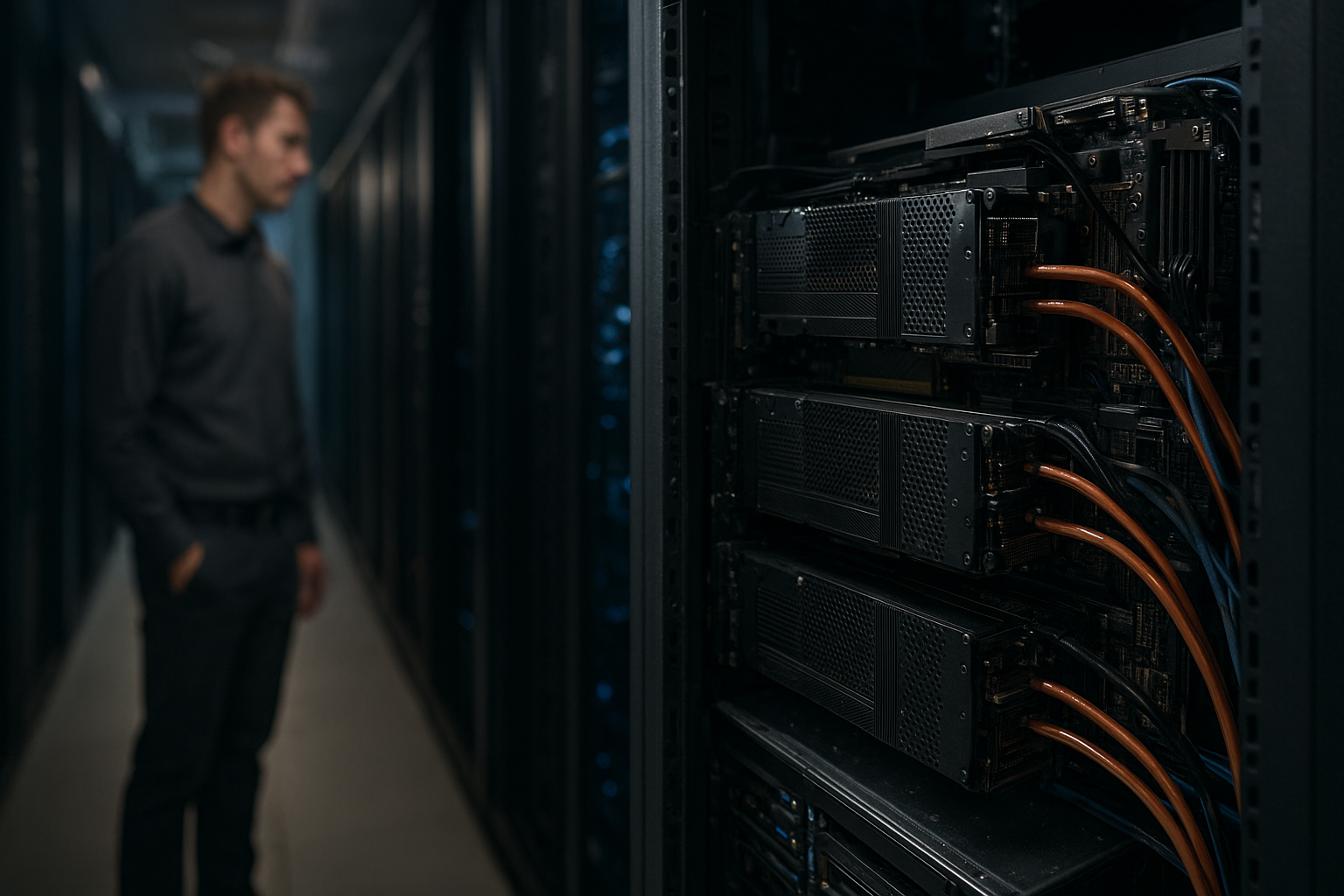
NVIDIA Blackwell architecture is the design foundation behind NVIDIA’s B200 and GB200 platforms for large-scale AI, scientific computing, and data-center workloads. It combines a new GPU design with second-generation Transformer Engine technology, faster GPU-to-GPU communication, secure multi-die packaging, and high-bandwidth HBM3e memory.
This guide explains how Blackwell GPUs work, what changed from Hopper, why the architecture matters for generative AI, and where its advantages may not justify the cost or complexity. It also distinguishes the architecture itself from the complete server platforms built around it.
Table of Contents
- What Is NVIDIA Blackwell Architecture?
- NVIDIA Blackwell Architecture Features
- Blackwell GPU Memory Architecture
- NVIDIA Blackwell Tensor Cores and Transformer Engine
- NVIDIA Blackwell NVLink and Scale-Up Systems
- Blackwell Generative AI Capabilities and Use Cases
- Blackwell vs. Hopper: What Changed?
- Advantages, Limitations, and Buying Guidance
- Key Takeaways
- Frequently Asked Questions
- Conclusion
What Is NVIDIA Blackwell Architecture?
Blackwell is NVIDIA’s successor to the Hopper architecture used in products such as the H100. It is not a single graphics card or fixed server configuration. Instead, it is a family of GPU and platform technologies that NVIDIA adapts for different products, including standalone data-center GPUs and Grace Blackwell superchips.
The architecture targets workloads that place unusual demands on three resources: matrix-compute throughput, memory bandwidth and capacity, and communication between accelerators. Those demands arise in large language model training, inference, recommendation systems, simulation, data analytics, and other high-performance computing applications.
At a high level, Blackwell brings together:
- Large-scale GPU compute built around a two-die package design.
- Fifth-generation Tensor Cores for AI and matrix operations.
- A second-generation Transformer Engine designed to improve the efficiency of transformer models.
- HBM3e memory for high bandwidth and increased capacity in supported products.
- A fifth-generation NVLink interconnect for linking many GPUs in a shared scale-up domain.
- Confidential-computing features intended to protect data while it is being processed.
- Decompression hardware aimed at reducing the cost of certain data-intensive operations.
The result is best understood as a complete computing platform, not simply a faster conventional gaming GPU. Blackwell products depend on specialized server boards, cooling, networking, software libraries, and power delivery. A Blackwell accelerator can be extremely capable, but its real-world value depends on how effectively the surrounding system feeds and connects it.
NVIDIA Blackwell Architecture Features
Multi-die GPU design
One of the defining changes in the Blackwell GPU architecture is its use of two dies in a single package. NVIDIA describes the package as containing two reticle-sized dies connected through a high-speed interface, allowing them to operate as one GPU from the software perspective.
Very large chips are difficult to manufacture because a larger die has a greater chance of containing a defect. A multi-die approach can make it possible to build a large logical processor from more manageable pieces, although the package and inter-die connection must provide sufficiently low latency and high bandwidth.
This design should not be confused with two ordinary graphics cards joined by an external bridge. The dies are integrated at the package level, while the operating system and CUDA software generally expose the resulting device as one accelerator.
Fifth-generation Tensor Cores
Tensor Cores perform specialized matrix operations that dominate many deep-learning workloads. In Blackwell, the fifth-generation Tensor Cores support the data types and matrix instructions used by modern AI models, including lower-precision formats that can improve throughput when the model and software support them.
Lower precision does not mean that every calculation becomes less accurate. AI frameworks often use mixed-precision techniques: some operations use compact formats for speed and memory efficiency, while others retain higher precision to preserve model quality and training stability.
The practical benefit depends on more than the theoretical Tensor Core rate. A workload must use compatible kernels, have suitable matrix dimensions, and avoid becoming limited by memory movement, synchronization, or data preparation.
Second-generation Transformer Engine
The Blackwell Transformer Engine extends NVIDIA’s earlier approach of dynamically selecting numerical precision for transformer workloads. Transformers power large language models, many image-generation systems, speech models, and a growing range of multimodal applications.
The system can use lower-precision computation where the model tolerates it and apply scaling or higher-precision handling where needed. NVIDIA also introduced support for the FP4 data format in Blackwell’s AI-focused design. FP4 can reduce the amount of data moved and stored for compatible inference workloads, but it is not a universal replacement for FP8, FP16, BF16, or FP32.
Software support is central to this feature. Frameworks, quantization tools, model kernels, and deployment engines must understand the relevant formats. Without that support, a model may not receive the expected benefit from the Transformer Engine.
Secure processing and decompression
Blackwell includes a decompression engine intended to accelerate data decompression in selected workloads. This can help when compressed data must be expanded before analytics or other processing, reducing the work handled by general-purpose CPU resources.
The architecture also adds confidential-computing capabilities to protect data and model operations in use. The exact security model depends on the GPU, host platform, firmware, virtualization layer, and software configuration. Confidential computing should therefore be treated as a system feature, not merely a switch inside the GPU.
For security-sensitive deployments, administrators should review NVIDIA’s platform documentation and validate isolation, attestation, key management, and performance requirements before making architectural assumptions.
Blackwell GPU Memory Architecture
The Blackwell GPU memory architecture is built around high-bandwidth memory, fast on-package data paths, and a hierarchy that keeps frequently used data close to the compute units. In AI systems, memory capacity and bandwidth can matter as much as raw arithmetic performance because models repeatedly read weights, activations, attention data, and intermediate results.
HBM3e memory
Blackwell data-center products use HBM3e in configurations that vary by product. HBM is placed close to the GPU package and provides much more bandwidth than conventional system memory. That proximity helps feed Tensor Cores and other execution resources without relying on a relatively slow trip across a standard server memory bus.
Memory capacity still imposes a hard limit. If a model, context window, or batch does not fit in local HBM, the system may need to shard it across GPUs or move data over an interconnect. Those techniques can work well, but communication and synchronization add complexity.
For inference, larger memory capacity can allow more model weights, longer context, or larger batches to remain resident. For training, memory is consumed not only by weights but also by gradients, optimizer states, activations, and temporary buffers.
Memory bandwidth is not the same as memory capacity
These terms are often treated as interchangeable, but they solve different problems:
- Capacity determines how much data can remain in memory at once.
- Bandwidth determines how quickly data can be transferred when it is accessed.
- Latency determines how long the processor waits before data begins arriving.
- Locality determines whether data can be reused from a nearer cache or buffer.
A workload that repeatedly streams large tensors may benefit from bandwidth, while a workload that fails because its model does not fit may need more capacity. NVLink can help distribute data across multiple GPUs, but it does not turn separate memory pools into one magically latency-free pool.
How Blackwell handles large models
Large models are commonly partitioned using techniques such as tensor parallelism, pipeline parallelism, expert parallelism, or combinations of them. Blackwell platforms are designed to make communication-heavy parallel workloads more practical, particularly when many GPUs are connected in a tightly integrated server system.
Even so, software placement matters. Poor partitioning can cause frequent cross-GPU transfers, idle accelerators, and lower utilization. The best configuration depends on model architecture, batch size, sequence length, precision, and the communication pattern of the training or inference framework.
NVIDIA Blackwell Tensor Cores and Transformer Engine
The relationship between NVIDIA Blackwell Tensor Cores and the Transformer Engine explains much of Blackwell’s AI focus. Tensor Cores provide the matrix-multiplication hardware; the Transformer Engine helps determine how transformer operations can use different precisions and scaling strategies.
A simplified transformer layer may involve:
- Linear projections that create queries, keys, and values.
- Attention calculations that compare tokens with one another.
- Feed-forward matrix operations.
- Normalization, residual connections, and activation functions.
Matrix operations are especially suitable for Tensor Cores. However, real model execution also involves memory movement, reductions, communication, data-layout conversions, and non-matrix operations. That is why a benchmark measuring one highly optimized matrix kernel should not be used to predict every application.
FP4, FP8, and mixed precision
Blackwell’s support for FP4 is primarily relevant to AI inference and other workloads where aggressive quantization can preserve acceptable output quality. Reducing precision can lower memory use and increase the amount of data processed per operation, but the model must be calibrated and tested.
FP8 and other mixed-precision formats remain important for training and inference. Choosing between formats involves a trade-off among accuracy, throughput, memory footprint, software maturity, and model sensitivity. A model that performs well with FP4 in one deployment may require a higher-precision format in another.
Teams evaluating Blackwell should measure end-to-end tokens per second, latency at the required batch size, output quality, power use, and cost per useful result. Peak AI operations alone do not provide enough information.
NVIDIA Blackwell NVLink and Scale-Up Systems
NVIDIA Blackwell NVLink is the high-speed communication layer used to connect GPUs within a scale-up system. The fifth-generation NVLink introduced for Blackwell is designed for large multi-GPU configurations and supports the frequent exchange of activations, gradients, parameters, and other data required by distributed AI workloads.
This differs from ordinary networking between servers. A network fabric connects separate machines, while NVLink is intended to provide a much tighter GPU-to-GPU communication path inside supported systems. Blackwell platforms may use NVLink together with NVIDIA networking technologies, including InfiniBand or Ethernet-based data-center networks, depending on the deployment.
Why interconnect performance matters
Consider a model split across eight or more GPUs. If each GPU computes part of a layer but must repeatedly exchange large tensors with its peers, the interconnect can become the limiting factor. Faster links reduce waiting time, but only when the software can schedule communication efficiently.
NVIDIA’s GB200 NVL72 platform illustrates this scale-up direction: it combines Grace CPUs and Blackwell GPUs into a rack-scale system designed for large model training and inference. That configuration is not equivalent to buying a single B200 accelerator. It requires specialized infrastructure, thermal engineering, and system-level software.
For a useful overview of NVIDIA’s platform approach, compare the architecture information with the company’s official NVIDIA Blackwell platform documentation. Product configurations and availability can change, so system buyers should consult current technical specifications rather than rely on launch summaries.
Blackwell Generative AI Capabilities and Use Cases
The main reason organizations are interested in Blackwell is its potential to run larger generative AI workloads at practical throughput. The architecture addresses several bottlenecks at once: matrix computation, model memory, precision efficiency, and accelerator communication.
Large language model training
Training a large language model requires repeated passes over enormous datasets. Each step combines forward computation, backward propagation, optimizer updates, and communication across many accelerators.
Blackwell can help in this setting through faster Tensor Core operations, larger high-bandwidth memory configurations, and high-speed GPU interconnects. The gains depend on the training stack, including the framework, compiler, communication libraries, data pipeline, and checkpointing system.
LLM and multimodal inference
Inference has different bottlenecks from training. Serving users may require low first-token latency, high sustained token throughput, or both. Long context windows increase the amount of attention-related data, while large batches increase utilization but may also raise latency.
Blackwell’s lower-precision capabilities can reduce the memory and compute cost of compatible models. That may allow a service to host a larger model on a given GPU or serve more concurrent requests. The result should be validated with the intended model, prompts, context lengths, and service-level targets.
Recommendation, search, and analytics
Not every AI workload is a chatbot. Recommendation systems use embeddings and large matrix operations, while search systems may combine retrieval, ranking, and generative responses. Blackwell’s decompression features and high memory bandwidth may be useful in data-heavy pipelines, although a CPU, a previous-generation GPU, or a specialized accelerator could be more economical for some stages.
Scientific computing and simulation
HPC applications can benefit from accelerated matrix operations and tightly connected GPUs, particularly when simulations involve large systems of equations or AI-assisted scientific models. However, scientific codes vary widely. Some depend more heavily on double-precision arithmetic, sparse memory access, or CPU performance than on transformer-oriented features.
Before selecting Blackwell for traditional HPC, teams should examine the application’s precision requirements and confirm that its libraries have optimized support. The architecture’s AI strengths do not automatically translate into equal gains for every scientific workload.
Blackwell vs. Hopper: What Changed?
Blackwell extends several ideas introduced with Hopper while adding new hardware for larger models and newer numerical formats. The comparison below describes architectural direction rather than promising a fixed performance improvement for every workload.
| Area | Hopper generation | Blackwell generation | Why it matters |
|---|---|---|---|
| GPU construction | Large monolithic GPU designs in major data-center products | Two-die package approach for the flagship design | Enables a very large logical GPU while addressing reticle and manufacturing constraints |
| AI compute | Fourth-generation Tensor Cores | Fifth-generation Tensor Cores | Supports newer AI data types and higher matrix-processing capability |
| Transformer optimization | First-generation Transformer Engine | Second-generation Transformer Engine | Improves precision management for supported transformer workloads |
| Memory | HBM configurations vary by Hopper product | HBM3e configurations vary by Blackwell product | Provides a newer memory option for capacity- and bandwidth-intensive models |
| GPU interconnect | Fourth-generation NVLink in supported systems | Fifth-generation NVLink in supported systems | Targets larger and more communication-intensive multi-GPU deployments |
| Data processing | General accelerator and platform features | Includes a dedicated decompression engine | Can reduce overhead for selected compressed-data workloads |
| Security | Confidential-computing support in supported Hopper platforms | Expanded confidential-computing direction | Helps address protected data and model processing requirements |
The correct conclusion is not that every Hopper system has become obsolete. Hopper remains suitable for many deployments, and an existing cluster with mature software may deliver better value than a new Blackwell installation. Blackwell is most compelling when its newer precision modes, memory configuration, scale-up interconnect, or performance-per-rack advantages match a real workload.
NVIDIA’s CUDA Toolkit resources and related libraries are useful starting points for checking software compatibility. Teams should also confirm support in their framework, inference server, monitoring tools, and orchestration environment.
Advantages, Limitations, and Buying Guidance
Advantages of Blackwell
- Strong fit for transformer workloads: Tensor Cores and Transformer Engine target the operations used by current generative AI models.
- Better support for low-precision AI: FP4 and other formats can reduce memory traffic and improve efficiency when model quality remains acceptable.
- High-bandwidth memory: HBM3e configurations can help keep large models and intermediate data close to the compute hardware.
- Scale-up communication: NVLink is designed for systems in which GPUs exchange data frequently.
- System-level features: Confidential computing and decompression address needs beyond raw arithmetic performance.
- Broad software ecosystem: CUDA, optimized libraries, and established AI frameworks can reduce development work compared with a less mature accelerator platform.
Limitations and trade-offs
- Infrastructure requirements: High-end Blackwell systems require substantial power, cooling, rack space, and facility planning.
- Cost and availability: Accelerator acquisition is only part of the budget; networking, storage, host CPUs, software, and support also affect total cost.
- Software dependency: New precision modes and hardware features need framework and kernel support to deliver their potential.
- Not ideal for every workload: Small models, lightly parallel applications, and CPU-oriented tasks may not use the architecture efficiently.
- Complex deployment: Multi-GPU parallelism, model sharding, checkpointing, and thermal management require specialist expertise.
- Performance is workload-specific: Published peak figures cannot predict latency, throughput, or cost for an untested model and configuration.
Who should consider Blackwell GPUs?
Blackwell is a strong candidate for organizations training or serving large models, operating high-throughput inference services, or building dense multi-GPU clusters. It is also worth evaluating when power, rack density, or communication overhead limits an existing Hopper or older-generation deployment.
Cloud providers and large enterprises may benefit from the rack-scale approach because they can spread infrastructure costs across many workloads. Research groups working with very large models may also value the memory and interconnect capabilities, provided they have access to suitable systems.
Who should avoid an immediate upgrade?
A small team running modest models may get better value from a cloud instance, a previous-generation accelerator, or a single-GPU workstation. Blackwell’s advanced features cannot compensate for low utilization or an application that spends most of its time waiting on storage, networking, or CPU preprocessing.
Organizations should also delay a purchase if their software stack cannot yet use the required data types or multi-GPU communication patterns. A benchmark using the actual model and deployment target is more useful than a specification-sheet comparison.
A practical evaluation checklist
- Measure the model’s memory footprint, including weights, activations, KV cache, optimizer states, and framework overhead.
- Identify whether the workload is compute-bound, memory-bandwidth-bound, communication-bound, or limited by input data.
- Test the intended precision modes and compare output quality against a higher-precision baseline.
- Benchmark realistic batch sizes, sequence lengths, concurrency, and latency targets.
- Estimate total cost, including servers, networking, power, cooling, software, support, and migration.
- Confirm that drivers, CUDA libraries, frameworks, inference engines, and monitoring systems support the chosen product.
- Plan for failure recovery, checkpoint storage, cluster scheduling, and capacity growth.
For technical background on the numerical formats and programming model behind NVIDIA accelerators, the NVIDIA CUDA documentation provides authoritative reference material. It should be read alongside product-specific documentation because the capabilities exposed to software can differ by GPU and platform.
Key Takeaways
- NVIDIA Blackwell architecture is a data-center GPU and platform design, not a single graphics card.
- Its flagship design uses two GPU dies in one package to create a large logical accelerator.
- Fifth-generation Tensor Cores and the second-generation Transformer Engine target modern AI and transformer workloads.
- HBM3e addresses memory bandwidth and capacity, while NVLink addresses communication between GPUs.
- FP4 can improve efficiency for compatible AI inference workloads, but precision must be validated for each model.
- Blackwell systems can be powerful without being the right choice for small or poorly optimized workloads.
- End-to-end benchmarks and total cost of ownership matter more than peak theoretical performance.
Frequently Asked Questions
What is NVIDIA Blackwell architecture?
NVIDIA Blackwell architecture is the design used in a new generation of data-center GPUs and AI platforms. It combines a multi-die GPU package, fifth-generation Tensor Cores, a second-generation Transformer Engine, HBM3e memory in supported products, and faster NVLink connectivity. Blackwell is aimed mainly at generative AI, high-performance computing, and large-scale data-center workloads rather than ordinary consumer graphics.
How does Blackwell differ from Hopper?
Blackwell extends Hopper with newer Tensor Cores, more advanced transformer precision handling, a flagship two-die package design, newer HBM3e memory configurations, and fifth-generation NVLink. It also adds features such as hardware decompression and an expanded confidential-computing direction. The practical improvement depends on the application, software stack, model precision, and whether the workload benefits from multi-GPU communication.
What are NVIDIA Blackwell Tensor Cores used for?
NVIDIA Blackwell Tensor Cores accelerate matrix operations used heavily in neural-network training and inference. They are particularly relevant to transformer layers, which contain large numbers of matrix multiplications. The cores support multiple numerical formats, allowing software to balance speed, memory use, and accuracy. They do not automatically accelerate every part of an AI application, so data loading, communication, and non-matrix operations still affect total performance.
What is the Blackwell Transformer Engine?
The Blackwell Transformer Engine is hardware and software technology for managing numerical precision in transformer workloads. It can use formats such as FP8 and FP4 where appropriate, with scaling and precision choices intended to maintain model quality. Its value depends on framework, kernel, and model support. FP4 should be evaluated through quality and end-to-end performance tests rather than assumed to be suitable for every model.
What memory does a Blackwell GPU use?
Supported Blackwell data-center GPUs use HBM3e memory, although capacity and configuration vary between products. HBM3e provides high bandwidth and sits close to the GPU package, which helps feed compute resources with data. Memory capacity remains a separate constraint: if a model does not fit in local HBM, it must be distributed across GPUs or use other memory levels, adding software and communication overhead.
What is NVIDIA Blackwell NVLink?
NVIDIA Blackwell NVLink is a high-speed interconnect for linking GPUs within supported scale-up systems. It is designed for workloads that frequently exchange activations, gradients, parameters, or other tensors. NVLink is not the same as ordinary server networking, and it does not eliminate the cost of distributing a model across separate memory pools. Its benefits are greatest when the software parallelizes the workload efficiently.
Are Blackwell GPUs suitable for gaming PCs?
Blackwell architecture describes NVIDIA’s data-center generation, including products such as B200 and GB200 platforms. A data-center Blackwell accelerator is not a normal gaming graphics card and is not intended for a typical desktop PC. Consumer GeForce products may use related design ideas or a different implementation, but buyers should compare the specifications and software support of the actual consumer product rather than assume that a data-center GPU is a practical gaming upgrade.
Conclusion
NVIDIA Blackwell architecture is built around a clear data-center priority: keeping large AI models computing, storing, and communicating efficiently at scale. Its multi-die package, Tensor Cores, Transformer Engine, HBM3e memory, and NVLink interconnect address different bottlenecks, so the strongest results come from using them as a coordinated platform.
Before choosing Blackwell, profile the target workload and benchmark the real model at realistic precision, batch size, context length, and concurrency. If the workload is dominated by large transformer operations or multi-GPU communication, Blackwell deserves serious consideration. If it is small, CPU-bound, or poorly supported by the software stack, a less complex system may deliver better value.