
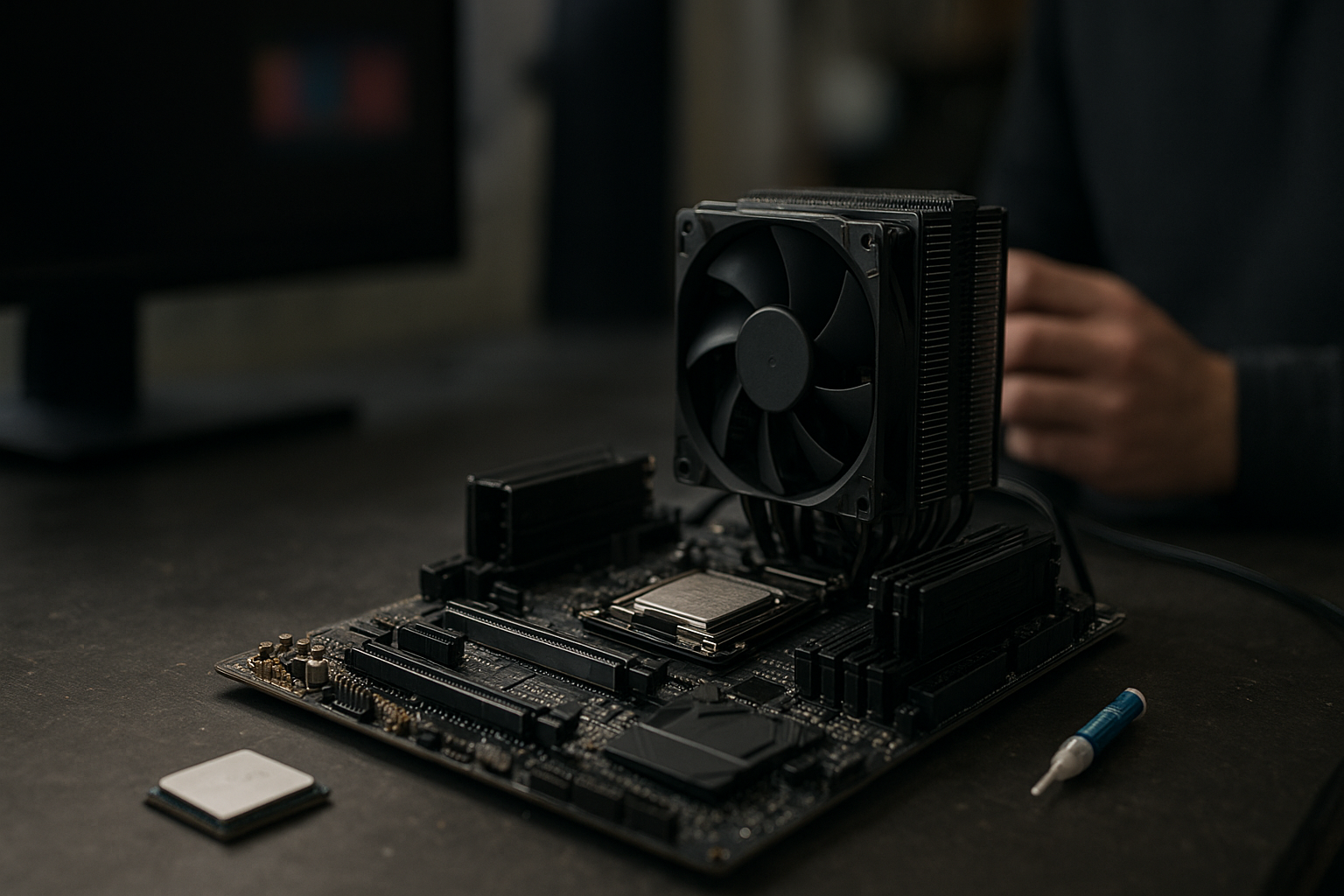
A useful Ryzen 7 9850X3D review must do more than confirm that AMD’s latest gaming chip is fast. It should identify which specifications and test results are verified, compare the processor with the Ryzen 7 9800X3D, and determine whether any performance advantage justifies the total platform cost.
Because processor pricing, firmware support, BIOS behavior, and independent benchmark results can all influence a buying decision, this article takes a verification-first approach. It separates confirmed buying guidance from figures that should not be treated as fact until AMD publishes a product page and reputable reviewers test retail hardware.
Table of Contents
- What This Ryzen 7 9850X3D Review Can Confirm
- Architecture, 3D V-Cache, and the AM5 Platform
- Ryzen 9850X3D Gaming Performance: What to Measure
- Ryzen 7 9850X3D Benchmarks Beyond Gaming
- Ryzen 7 9850X3D Power Consumption and Cooling
- Ryzen 9850X3D vs Ryzen 7 9800X3D
- Ryzen 7 9850X3D Price and Value
- Who Should Buy It?
- Key Takeaways
- Frequently Asked Questions
- Conclusion
What This Ryzen 7 9850X3D Review Can Confirm
The first question is straightforward: is the Ryzen 7 9850X3D an officially documented, independently tested retail processor? A trustworthy review should draw on AMD’s product specifications, retail availability, motherboard support documentation, and repeatable testing from multiple outlets. Without those sources, exact core counts, clock speeds, cache totals, launch pricing, power limits, and benchmark scores should not be presented as confirmed facts.
That distinction matters because model-number leaks and retailer listings can contain errors. A name in a database does not prove that a processor has launched, and an engineering sample may behave differently from a retail chip running final firmware.
AMD’s official Ryzen 9000 desktop processor information is the right starting point for verifying a model’s specifications. Buyers should also confirm that the processor appears on their motherboard manufacturer’s CPU support list before purchasing.
Why unverified benchmark charts are risky
A benchmark result is useful only when its test conditions are clear. Memory speed, BIOS version, Windows build, graphics card, game patch, cooling, background software, and power settings can all affect the outcome. A chart showing a percentage advantage without listing those details is not enough to establish a reliable performance lead.
This is particularly true for X3D processors. Extra cache can deliver a large improvement in some games, a small improvement in others, and almost no improvement in workloads limited by the graphics card or compute throughput.
Architecture, 3D V-Cache, and the AM5 Platform
By name, the AMD Ryzen 7 9850X3D belongs to AMD’s X3D family of desktop processors. AMD 3D V-Cache processors place additional cache memory close to the CPU compute complex. The goal is to keep more game data near the cores, reducing the need to fetch some information from slower levels of the memory hierarchy.
This design is primarily a gaming strategy. Modern games often perform many small, repeated data accesses, and a larger cache can reduce memory latency penalties in selected engines. It does not automatically make every application faster, nor does it replace the need for strong single-threaded and multi-threaded CPU performance.
The processor also belongs to the AM5 ecosystem if the model follows AMD’s current desktop platform. That generally means buyers must account for an AM5 motherboard, DDR5 memory, a compatible cooler, and a BIOS version that recognizes the chip. The socket alone does not guarantee out-of-the-box support.
Motherboard and memory considerations
A premium motherboard is not automatically necessary for a gaming-focused build. A well-reviewed board with adequate power delivery, current firmware, useful USB connectivity, and the features you need is usually a better choice than paying for features that will go unused.
Memory selection deserves the same attention. When possible, use a matched DDR5 kit listed on the motherboard’s memory compatibility page, then test stability after enabling the board’s memory profile. An unstable memory overclock can look like a CPU problem and can also create inconsistent benchmark results.
- Update the motherboard BIOS before installing the processor when the board supports BIOS flashback.
- Check the board vendor’s CPU support list rather than relying only on the socket name.
- Use two matched memory modules unless your workload specifically requires more capacity.
- Leave room in the case for a capable cooler and unobstructed front-to-back airflow.
Ryzen 9850X3D Gaming Performance: What to Measure
The most important measure of Ryzen 9850X3D gaming performance is not a single average frame-rate figure. A meaningful comparison should cover average frames per second, one-percent lows, frame-time consistency, and the resolution at which the processor was tested.
At 1080p with a high-end graphics card, the CPU has more influence, making differences between processors easier to see. At 1440p, the graphics card often becomes the stronger limit. At 4K, many games are predominantly GPU-bound, so a faster gaming CPU may produce little visible improvement unless the system uses a very powerful GPU or targets a high refresh rate.
How to interpret Ryzen 7 9850X3D benchmarks
Gaming benchmarks should cover a representative range of engines rather than focusing only on titles that favor a particular architecture. A balanced test suite might include a competitive game with a high frame-rate target, a large open-world title, a simulation or strategy game, a racing game, and a modern graphics-heavy release.
Testers should run each benchmark several times after shader compilation and report the median or average of repeatable runs. One unusual result should prompt further testing, not become the headline claim.
| Test condition | Why it matters | What a buyer should look for |
|---|---|---|
| 1080p with a high-end GPU | Exposes CPU limits and frame-rate ceilings | Average performance and one-percent lows |
| 1440p with the intended GPU | Reflects a common enthusiast gaming setup | Whether the CPU advantage remains visible in real use |
| 4K gaming | Shows how often the GPU becomes the bottleneck | Small CPU differences should not be overvalued |
| Simulation and strategy games | These can respond strongly to CPU and cache behavior | Turn times, simulation speed, and consistent frame pacing |
| Streaming or recording while gaming | Background workloads can change CPU utilization | Whether performance remains stable under simultaneous loads |
For competitive gaming, the best processor is not necessarily the one with the highest average frame rate. Stable frame times and sufficient headroom for voice chat, recording, browser tabs, and anti-cheat software can matter more than a small lead in an isolated benchmark.
GPU selection also changes the conclusion. Pairing a flagship graphics card with the Ryzen 7 9850X3D may reveal a CPU difference that disappears when the same processor is paired with a mid-range card. Buyers should align CPU spending with their monitor, graphics card, and upgrade plan.
Ryzen 7 9850X3D Benchmarks Beyond Gaming
A gaming-focused X3D processor can still handle general desktop work, but buyers should not assume that a cache-focused model is the fastest option for every professional task. Video encoding, code compilation, 3D rendering, scientific workloads, and batch photo processing may favor more cores, higher sustained power, or a different processor family.
Useful productivity testing should include both short burst workloads and long sustained runs. A chip that finishes a brief benchmark quickly may behave differently after several minutes of heat buildup, especially if the cooler, motherboard limits, or fan curve restrict sustained boost behavior.
Workloads where cache can help
Cache-sensitive software may benefit from keeping frequently used data closer to the cores. Some simulation, game-development, and technical workloads can respond well, but the result depends on the application’s access pattern. The presence of 3D V-Cache is not a guarantee of a gain.
Workloads where core count matters more
Rendering and heavily parallel encoding usually depend more on available cores, thread scheduling, instruction throughput, and sustained cooling. If the computer will spend most of its time rendering or compiling, compare the 9850X3D with processors designed for that workload rather than choosing solely from gaming charts.
For a mixed-use PC, list the applications that matter and assign them priorities. A small gaming lead may be worth paying for if games are the primary use, while a workstation user may save time and money with a CPU that is slower in games but faster in daily production tasks.
Ryzen 7 9850X3D Power Consumption and Cooling
Ryzen 7 9850X3D power consumption should be evaluated at the wall, at the CPU package, and across both gaming and all-core workloads. These measurements answer different questions: wall power reflects the whole system, while package power helps explain CPU behavior and cooler requirements.
Gaming power can be much lower than an all-core render, so a single number does not represent every use case. Reviewers should also report room temperature, cooler model, motherboard power settings, fan profile, and workload duration.
Choosing a cooler
Do not choose a cooler based only on a theoretical peak temperature. A quality tower air cooler or appropriately sized liquid cooler may be suitable, but the right choice depends on the final thermal specification, case airflow, ambient temperature, noise target, and motherboard behavior.
- Confirm the cooler includes AM5 mounting hardware.
- Check clearance around tall memory modules and the motherboard’s VRM heatsinks.
- Prefer a cooler with a clear manufacturer performance rating and a strong warranty.
- Use a balanced fan curve instead of forcing maximum fan speed at all times.
- Monitor temperature and clock behavior during a sustained workload, not just during a short boot test.
Temperature alone does not determine whether a CPU is operating correctly. Modern processors can intentionally use available thermal headroom to maintain performance. More useful questions are whether clocks remain stable, whether the system throttles, whether noise is acceptable, and whether performance is repeatable.
Ryzen 9850X3D vs Ryzen 7 9800X3D
The Ryzen 9850X3D vs Ryzen 7 9800X3D comparison should start with verified differences, not the assumption that a higher model number always delivers a worthwhile upgrade. The 9800X3D is an established reference point for an X3D gaming build, while the newer model would need to show a measurable advantage in the games and resolution the buyer actually uses.
Compare the two processors using the following checklist:
- Official specifications, including cores, threads, cache, supported memory, and power limits.
- Launch and current street price from reputable retailers.
- Average frame rate and one-percent lows across several games.
- Power consumption, noise, and temperatures under gaming and sustained CPU loads.
- BIOS requirements and motherboard compatibility.
- Warranty terms and local availability.
| Decision factor | Ryzen 7 9850X3D | Ryzen 7 9800X3D |
|---|---|---|
| Verified specification | Confirm on AMD’s official product page before buying | Use AMD’s published specification and motherboard support information |
| Gaming advantage | Requires independent, repeatable retail benchmarks | Use current reviews and your target games as the baseline |
| Platform cost | AM5 board, DDR5 memory, cooler, and possible BIOS update | Same platform costs, subject to board compatibility |
| Upgrade justification | Should depend on measured gains and price difference | Often makes sense when discounted and fast enough for the target GPU |
| Best buyer profile | Enthusiast seeking the highest verified gaming performance | Buyer prioritizing known behavior and established value |
If the 9850X3D is only slightly faster but substantially more expensive, the 9800X3D may deliver the better gaming experience per dollar. If the price gap is narrow and the newer chip offers a consistent improvement in CPU-limited games, the newer model becomes easier to recommend.
Users upgrading from a slower AM5 processor should also compare the total upgrade cost. A CPU-only upgrade may be attractive if the existing motherboard and cooling solution are compatible. Moving from an older platform, however, requires budgeting for the board and DDR5 memory as well as the processor.
Ryzen 7 9850X3D Price and Value
Ryzen 7 9850X3D price and value cannot be judged responsibly without a verified retail price and genuine availability. Suggested launch pricing is not the same as the amount buyers pay after retailer discounts, bundles, stock shortages, and regional taxes.
Assess platform value rather than comparing CPU prices in isolation. The relevant total includes the processor, motherboard, memory, cooler if needed, and any required BIOS service. A slightly cheaper CPU can become the more expensive choice if it requires a new board or premium memory kit.
A practical value calculation
Start with the games you play and the frame rate your monitor can display. If a graphics card limits performance at your chosen settings, spending more on the CPU will not produce a proportional improvement. The extra budget may be better directed toward a faster GPU, a larger SSD, or a higher-refresh monitor.
With a high-end graphics card and a 240 Hz display, CPU performance can matter more. In that case, compare the cost of the 9850X3D with the cost of stepping down to the 9800X3D and investing the difference elsewhere. The best choice is the one that removes the actual bottleneck in your system.
- Write down your target resolution, refresh rate, and graphics card.
- Check independent benchmarks at that resolution using similar settings.
- Compare complete platform prices, not processor prices alone.
- Allow for cooling, BIOS updates, and a realistic power supply.
- Recheck retailer pricing immediately before ordering.
Who Should Buy It?
The Ryzen 7 9850X3D may suit you if:
- You are building a high-refresh-rate gaming PC and use a powerful graphics card.
- You play simulation, strategy, or competitive games that benefit from strong CPU performance and cache behavior.
- You already own an AM5 motherboard and can verify CPU support through a BIOS update.
- Independent reviews show a consistent advantage at a price premium you consider reasonable.
You may want to avoid it if:
- Your system is primarily limited by a mid-range graphics card at 1440p or 4K.
- You spend more time rendering, encoding, or compiling than gaming.
- The processor has no verified product page, retail stock, or trustworthy independent testing in your market.
- The Ryzen 7 9800X3D is substantially cheaper while delivering nearly the same gaming results.
- You would need to compromise on the graphics card to afford the CPU.
There is no universal best gaming CPU for PC builds. A competitive player with a top-end GPU, a creator who also games, and a budget-focused builder all have different priorities. Choose based on the complete system and the applications you actually run.
Key Takeaways
- A credible Ryzen 7 9850X3D review needs verified specifications, retail hardware, and repeatable independent benchmarks.
- 3D V-Cache can improve selected games, but it does not guarantee gains in every title or productivity application.
- Test results should include frame-time data, target resolution, graphics card, BIOS version, and power settings.
- Ryzen 7 9850X3D power consumption should be measured during both gaming and sustained all-core workloads.
- The Ryzen 9850X3D vs Ryzen 7 9800X3D decision depends on the real price gap and the games you play.
- Complete platform cost includes the AM5 motherboard, DDR5 memory, cooling, and possible BIOS requirements.
- If the newer processor is not independently verified in your region, waiting is safer than relying on leaked specifications.
Frequently Asked Questions
Is the AMD Ryzen 7 9850X3D officially available?
Confirm availability through AMD’s official product database and reputable retailers in your region. A leaked listing, benchmark database entry, or social media post is not enough to establish that a processor has launched. Before buying, check for an official specification page, a motherboard CPU support entry, retail stock, warranty coverage, and independent testing of a retail sample.
How does the Ryzen 7 9850X3D compare with the Ryzen 7 9800X3D?
The comparison requires verified specifications, current prices, and independent game testing. A higher model number may indicate a newer or faster product, but it does not prove that the performance increase will be large enough to justify the price. Compare one-percent lows, CPU-limited games, power, temperatures, and total platform cost rather than relying on a single average frame-rate chart.
Is an X3D processor always the best gaming CPU for PC builds?
Not always. X3D processors are often compelling for high-refresh-rate gaming and cache-sensitive titles, but the graphics card usually determines performance at demanding settings and higher resolutions. A less expensive CPU paired with a faster GPU can deliver a better result for many 1440p and 4K systems. Workstation users may also prefer a processor with more cores or stronger sustained throughput.
What motherboard does the Ryzen 7 9850X3D require?
If it is an AM5 desktop processor, it will require an AM5 motherboard and DDR5 memory, but the exact chipset and BIOS requirement must come from AMD and the motherboard manufacturer. Do not assume every AM5 board supports every future CPU automatically. Check the board’s CPU support list, required BIOS version, update method, memory compatibility, and power-delivery specifications before ordering.
How much power does the Ryzen 7 9850X3D use?
There is no single useful number without a defined test condition. CPU package power, whole-system wall power, gaming power, and sustained all-core power can differ considerably. Wait for measurements from independent reviews that document the motherboard settings, BIOS, cooler, workload, and test duration. Those details are more useful than an isolated power figure copied from an unverified listing.
Does the Ryzen 7 9850X3D need liquid cooling?
Not necessarily. Cooler requirements depend on the processor’s confirmed power behavior, the motherboard’s settings, case airflow, ambient temperature, and your noise target. A strong air cooler may be sufficient for many gaming systems, while a liquid cooler can offer additional thermal capacity or fit a particular case. Confirm AM5 mounting support and review sustained temperatures rather than choosing based on the CPU name alone.
Should I buy the Ryzen 7 9800X3D instead?
The 9800X3D is the safer value choice when it has established availability, known firmware behavior, and a substantially lower price. The 9850X3D becomes more attractive only when verified reviews show a meaningful advantage in your games and the price premium fits your budget. If you are not in a hurry, compare real retail prices and several independent reviews shortly before purchase.
Conclusion
The central finding of this Ryzen 7 9850X3D review is that any buying recommendation must follow verified evidence. The processor could be an excellent choice for a high-refresh-rate AM5 gaming system, but cache branding and a higher model number cannot establish its real gaming lead, power behavior, or value.
Before purchasing, confirm AMD’s specifications, motherboard BIOS support, local retail pricing, and independent benchmarks at your target resolution. Then compare the complete build with the Ryzen 7 9800X3D. If the older model delivers nearly the same frame rates for less money, buy it and direct the savings toward the graphics card. If the newer chip shows a consistent, affordable advantage, it may earn a place in a premium gaming build.