
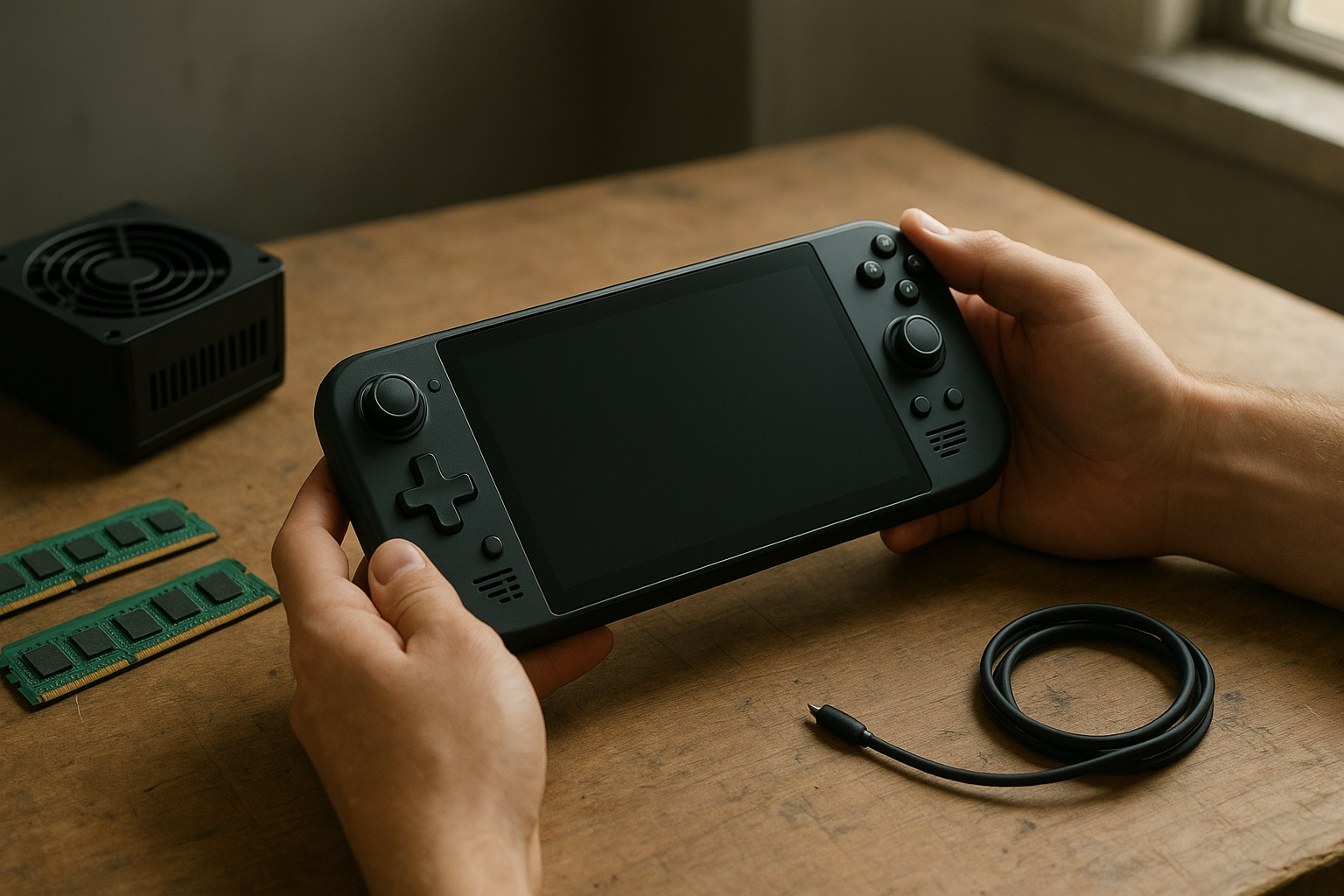
Intel Arc G3 is best understood as an emerging label tied to Intel’s interest in faster integrated graphics for thin laptops and handheld gaming PCs—not as a final product specification buyers can safely rely on. Intel has not provided a complete, universally documented Arc G3 product family with confirmed models, clocks, power limits, prices, or gaming benchmarks.
That distinction matters. A handheld’s real-world performance depends on its CPU cores, graphics architecture, memory bandwidth, cooling system, battery settings, drivers, and manufacturer-defined power configuration. This guide explains what the Intel Arc G3 name may indicate, which details remain unconfirmed, how to assess announcements, and what prospective buyers should check before choosing a portable gaming PC.
Table of Contents
- What Intel Arc G3 Means
- Why Arc G3 Matters for Handhelds
- What Is Confirmed and What Remains Unknown
- Arc G3 Performance Factors
- Comparing Handheld Graphics Without Inventing Benchmarks
- Games, Drivers, and Software Support
- Who Should Watch Intel Arc G3?
- Buying Checklist for an Arc G3 Handheld
- Key Takeaways
- Frequently Asked Questions
- Conclusion
What Intel Arc G3 Means
The phrase Intel Arc G3 appears to describe a graphics tier or family for integrated graphics rather than a conventional desktop graphics card. Intel’s Arc brand covers the company’s graphics technology, including integrated graphics in some Core Ultra processors and discrete Arc GPUs. A “G3” suffix would likely distinguish one performance class from another, but the label alone does not reveal the number of execution units, graphics cores, power target, or supported features.
That leads to the first practical lesson: a graphics label is not a benchmark. Two processors with similar graphics designations can perform differently when one handheld has faster memory, a higher sustained power limit, or better cooling.
Is Intel Arc G3 an official processor family?
Readers should treat Intel Arc G3 as an unconfirmed or incomplete product description unless it appears in an official Intel product brief, specification database, launch presentation, or retail device announcement. Intel has publicly used Arc branding for integrated and discrete graphics, but a product name needs more than a leaked slide, retailer listing, or social-media post before it can be considered final.
This cautious approach does not make the term useless. It offers a way to discuss Intel’s possible next step in handheld graphics while keeping confirmed information separate from expectations. Until Intel publishes full specifications, articles and listings using the name should not be read as confirmation of a particular performance level.
Why Arc G3 Matters for Handhelds
Handheld gaming PCs need efficient graphics hardware. Unlike a desktop, a handheld has limited battery capacity, a small cooling system, and a display that sits physically close to the player. A graphics processor that delivers strong performance at a moderate power level can improve frame rates, reduce fan noise, or allow a device maker to use a smaller battery without sacrificing as much play time.
Intel’s challenge is especially interesting because custom or semi-custom AMD designs have dominated handheld gaming. An Intel handheld gaming processor with competitive integrated graphics would give manufacturers another platform to consider and could encourage more choice in device designs.
Arc G3 integrated graphics could matter in several ways:
- More platform competition: Device makers would have another supplier for portable gaming PC chips.
- Better graphics features: Arc technology supports modern graphics APIs and hardware features, although the value depends on implementation and drivers.
- Improved media capabilities: Intel processors often target video encoding, decoding, and content-creation workloads alongside gaming.
- Flexible device designs: A manufacturer could tune the processor for a compact handheld, a mini PC, or a larger gaming tablet.
- Potentially stronger low-power gaming: This is a possibility, not a guaranteed result. Efficiency must be demonstrated in independent testing.
For buyers, the most meaningful comparison will not be “Arc G3 versus another brand” in isolation. It will be a comparison of complete handhelds running at similar power limits, with similar memory configurations, display resolutions, and current drivers.
What Is Confirmed and What Remains Unknown
Intel has established Arc as a graphics brand and has used Arc graphics in mobile processors. The company’s current product information and driver releases are more useful than a speculative model name because they show which hardware and software capabilities Intel officially supports.
However, the details that determine handheld PC performance may remain unavailable when a processor is only rumored. The following table separates information that can be evaluated from information that should not be assumed.
| Specification or question | What can be evaluated responsibly | What should not be assumed |
|---|---|---|
| Product identity | Whether Intel lists the processor in an official product database or brief | That every “Arc G3” reference describes the same chip |
| Graphics architecture | The architecture and feature support Intel officially documents | The exact graphics configuration from the G3 label alone |
| Power range | The manufacturer’s published sustained and configurable power limits | That a processor will run at a particular wattage in every handheld |
| Gaming performance | Independent tests using retail hardware and current drivers | Performance inferred from the name, a synthetic score, or a prototype |
| Battery life | Testing with a stated game, brightness, refresh rate, and power profile | A fixed battery-life figure across different handheld designs |
| Driver maturity | Intel’s release notes and tested game results | That all games will perform equally well at launch |
Specifications to look for in an Intel Arc G3 listing
A credible announcement should identify the processor model, CPU architecture, graphics architecture, memory type, supported power range, and display interfaces. It should also state whether the graphics are integrated into the processor and whether the device uses soldered memory or a replaceable module.
Memory deserves particular attention. Integrated graphics generally use system memory rather than dedicated video memory. Memory speed, channel configuration, capacity, and latency can therefore affect both frame rates and texture-heavy games. A handheld with the same Intel Arc graphics branding can perform differently if one model uses a faster dual-channel memory arrangement and another does not.
Intel Arc G3 Performance Factors
No single number predicts handheld gaming performance. The graphics engine is only one part of the system, and a compact device may not sustain the same power level as a laptop using the same processor.
Graphics compute capability
The number and design of the graphics resources influence how much work the processor can perform in parallel. Intel’s official specifications may use terminology such as Xe cores or execution resources, depending on the architecture. Those figures help identify product positioning, but they still do not replace game testing.
Clock behavior matters, too. A handheld may briefly boost to a high frequency and then reduce power or clock speed as heat builds up. Sustained performance is more relevant than a short peak, particularly during long sessions.
Memory bandwidth and capacity
Arc G3 integrated graphics would share access to system memory. Faster memory can feed the graphics engine more effectively, while insufficient capacity can force games to reduce texture quality or cause the operating system to rely more heavily on slower storage.
Buyers should check whether a proposed device has enough memory for its operating system, game, background applications, and graphics workload. Memory that cannot be upgraded makes the original configuration even more important.
Power limits and cooling
Handheld manufacturers typically offer several performance modes. A quiet battery-saving mode may prioritize efficiency, while a plugged-in turbo mode may allow higher graphics performance. The processor’s nominal power range does not guarantee that every device will offer the same modes.
Cooling determines whether the device can maintain its selected power level. A thicker handheld with a larger fan and heat spreader may outperform a thinner model using the same Intel handheld gaming processor, even if both devices advertise identical graphics branding.
Display resolution and upscaling
Rendering at 1,920 × 1,080 requires more graphics work than rendering at 1,280 × 800. A handheld with a high-refresh-rate display may also encourage lower settings or upscaling to keep games responsive.
Intel gaming graphics can benefit from modern upscaling and frame-generation technologies when a game and driver support them. These technologies can improve perceived smoothness, but they do not replace native rendering performance and may introduce image-quality or latency trade-offs.
Comparing Handheld Graphics Without Inventing Benchmarks
It is too early to assign Intel Arc G3 a definitive performance position without confirmed products and independent testing. A responsible comparison should therefore emphasize evaluation criteria rather than fabricated frame-rate claims.
| Comparison area | Why it matters in a handheld | Questions to ask |
|---|---|---|
| Performance at a fixed power limit | Shows efficiency more fairly than maximum performance alone | Were both devices tested at the same wattage and plugged-in state? |
| Long-session behavior | Reveals throttling caused by heat or firmware limits | Are results from a short run or a 30-minute-plus gaming session? |
| Memory configuration | Integrated graphics depend heavily on shared memory | How much memory is installed, and is it dual-channel or otherwise high bandwidth? |
| Driver support | Drivers can change compatibility and frame pacing | Were the latest official drivers used, and are known issues documented? |
| Battery efficiency | Determines how practical portable play will be | What game, brightness, refresh rate, and performance mode were used? |
| Software features | Upscaling, recording, and encoding can affect the overall experience | Do the tested games support the relevant features without major quality loss? |
For context, Intel’s official Arc graphics overview explains the broader product family, while Intel’s Core Ultra processor information shows how integrated graphics fit into the company’s mobile processor strategy. Neither page should be treated as confirmation of an unannounced Arc G3 handheld chip.
Arc G3 versus a discrete GPU handheld
Integrated graphics share power and memory resources with the CPU. A discrete GPU usually has its own graphics memory and a larger thermal budget, which can provide higher performance in demanding games. The trade-off is a larger system, higher power consumption, more heat, and often shorter battery life.
An Arc G3 device, if it arrives as an integrated solution, would likely occupy the middle ground: simpler and more efficient than a handheld with a separate graphics processor, but less powerful in peak rendering workloads. That positioning could suit players who value portability, battery flexibility, and everyday PC use over maximum settings.
Games, Drivers, and Software Support
Hardware capability does not guarantee a smooth experience in every game. Graphics drivers translate game instructions into hardware operations, and performance can vary between engines, APIs, shader workloads, and anti-cheat systems.
Intel has continued to publish graphics driver updates and game-focused release notes for Arc products. Buyers should consult the company’s official driver download center and check release notes for supported games, known issues, and operating-system requirements.
Windows handhelds will generally offer the broadest compatibility for PC game stores, launchers, and utilities. Linux-based devices can work well, but game support depends on the distribution, graphics stack, Proton compatibility, anti-cheat behavior, and the availability of device-specific controls.
Features beyond frame rate
Arc graphics may matter for more than game rendering. Video decoding and encoding can benefit streamers, remote-play users, and people who edit clips directly on a handheld. Display output, hardware video codec support, and software compatibility should be checked in the final processor documentation rather than inferred from the Arc name.
Upscaling support can also change the practical experience. A game that runs acceptably at a lower internal resolution may feel more responsive than one that struggles to maintain a higher native resolution. Reviewers should report the internal resolution, upscaling mode, image-quality setting, and frame-generation status so readers can compare results honestly.
Who Should Watch Intel Arc G3?
An Arc G3 handheld could appeal to several groups if retail products deliver competitive efficiency and reliable drivers.
- Players who want alternatives: More competition in handheld PC hardware could create a wider range of sizes, controls, and prices.
- Users who need a general-purpose PC: Intel-based handhelds may be attractive for desktop applications, streaming, and productivity as well as games.
- Players of older and moderately demanding games: These users may benefit more from efficient integrated graphics than from a very large discrete GPU.
- Manufacturers seeking flexible platforms: A mobile processor with capable graphics could fit handhelds, compact computers, and gaming tablets.
There are also clear reasons to wait. Buyers who want guaranteed performance in the latest graphically intensive releases should not choose a device solely because it mentions Intel Arc for handhelds. They should wait for independent reviews measuring sustained performance, compatibility, acoustics, and battery life.
Who should avoid early adoption?
Early adopters should be comfortable with driver updates and occasional game-specific troubleshooting. A new graphics platform may improve quickly, but launch software can still contain compatibility gaps that matter on a device with no easy hardware upgrade path.
Players who expect console-like simplicity may prefer a mature handheld ecosystem with well-documented performance profiles and extensive community testing. Similarly, users who mainly play demanding new releases at high settings should compare the final Arc G3 hardware with discrete-GPU alternatives rather than relying on branding.
Buying Checklist for an Arc G3 Handheld
If a manufacturer announces a handheld using Intel Arc G3 processors, use this checklist before placing an order:
- Verify the exact processor model. “Arc G3” may describe a tier, not a complete model number.
- Check the graphics architecture and official feature list. Look for documented API, display, encoding, and decoding support.
- Record the available power modes. A quoted maximum may apply only when plugged in or under short boost conditions.
- Inspect the memory configuration. Capacity and bandwidth are especially important for integrated graphics.
- Read long-session reviews. Sustained frame rates and fan noise matter more than a brief benchmark run.
- Check driver update procedures. Confirm whether drivers come from Intel, the handheld manufacturer, or both.
- Compare at the device level. Include screen resolution, battery size, weight, controls, storage, and software support.
- Look for game-specific testing. Favor reviews that show frame pacing and settings rather than a single headline average.
A useful review should identify the game version, graphics driver, operating system, power mode, resolution, upscaling settings, and whether the device was plugged in. Without that information, claims about handheld PC performance are difficult to reproduce.
Key Takeaways
- Intel Arc G3 should be treated as an emerging or unconfirmed graphics label until Intel publishes complete product details.
- The name alone does not establish graphics resources, power limits, frame rates, battery life, or pricing.
- Memory bandwidth, cooling, firmware, and drivers can change the results substantially between handhelds.
- Integrated Arc graphics could give Intel a stronger position in portable gaming PC chips, but retail testing must confirm that potential.
- Compare complete devices at matching power limits instead of comparing processor names in isolation.
- Wait for official specifications and independent long-session reviews before making a purchase decision.
Frequently Asked Questions
What is Intel Arc G3?
Intel Arc G3 appears to be a name or tier associated with Intel Arc integrated graphics for possible mobile or handheld products. It should not be treated as a complete, confirmed specification unless Intel identifies a specific processor and publishes technical details. The label does not by itself reveal graphics resources, power consumption, memory bandwidth, supported handheld configurations, or gaming performance.
Is Intel Arc G3 designed for handheld gaming PCs?
The terminology is relevant to handheld gaming PCs because integrated Arc graphics could be used in compact, battery-powered systems. However, a graphics tier is not proof that a particular handheld exists or that every device using the label will deliver the same performance. Final suitability will depend on the processor model, device cooling, memory, firmware, display resolution, and available power modes.
How fast will Intel Arc G3 processors be?
No reliable universal performance figure can be assigned without confirmed hardware and independent testing. Frame rates will vary with the game, resolution, quality settings, memory configuration, driver version, and sustained power limit. A credible comparison should test retail hardware over a long session and report the complete configuration rather than quoting a single synthetic benchmark or an early leak.
Will Arc G3 integrated graphics replace a discrete GPU?
Integrated graphics generally target lower power consumption and simpler device designs, while discrete GPUs usually offer more rendering resources and dedicated graphics memory. An Arc G3 handheld could be a good fit for older games, esports titles, indie releases, and moderately demanding software, but users seeking high settings in the newest releases may still prefer a larger device with a discrete GPU.
Does the Intel Arc G3 name guarantee good driver support?
No. Intel’s driver support history and update process are relevant, but a new product still needs game-by-game validation. Drivers can improve performance and compatibility over time, yet launch issues may affect particular games or operating systems. Before buying, check official release notes and reviews that test the games you actually play.
What should I compare when choosing an Arc G3 handheld?
Start with the exact processor model, graphics architecture, memory capacity and bandwidth, sustained power modes, cooling design, display resolution, battery, storage, and operating system. Then examine independent tests for frame pacing, fan noise, temperatures, battery life, and performance after at least several minutes of play. These details are more useful than the Arc G3 branding alone.
Should I buy a handheld based only on an Arc G3 announcement?
Usually, no. An announcement can establish that Intel or a device maker is targeting the category, but it may not reveal final firmware, power behavior, pricing, availability, or driver maturity. Wait for a complete specification sheet and independent retail reviews unless you are deliberately buying early hardware and accept the possibility of software limitations.
Conclusion
Intel Arc G3 could become a meaningful development for handheld gaming PCs if Intel pairs capable integrated graphics with strong efficiency, responsive drivers, and flexible power management. For now, the name is not enough to predict a specific level of handheld PC performance and should not replace confirmed specifications or independent benchmarks.
The next step is to track official Intel product documentation, identify the exact processor model in any announced device, and compare reviews using the same power, resolution, and game settings. That approach will reveal whether Arc G3 processors offer a genuine advantage—or simply add another label—to the growing portable gaming PC market.