
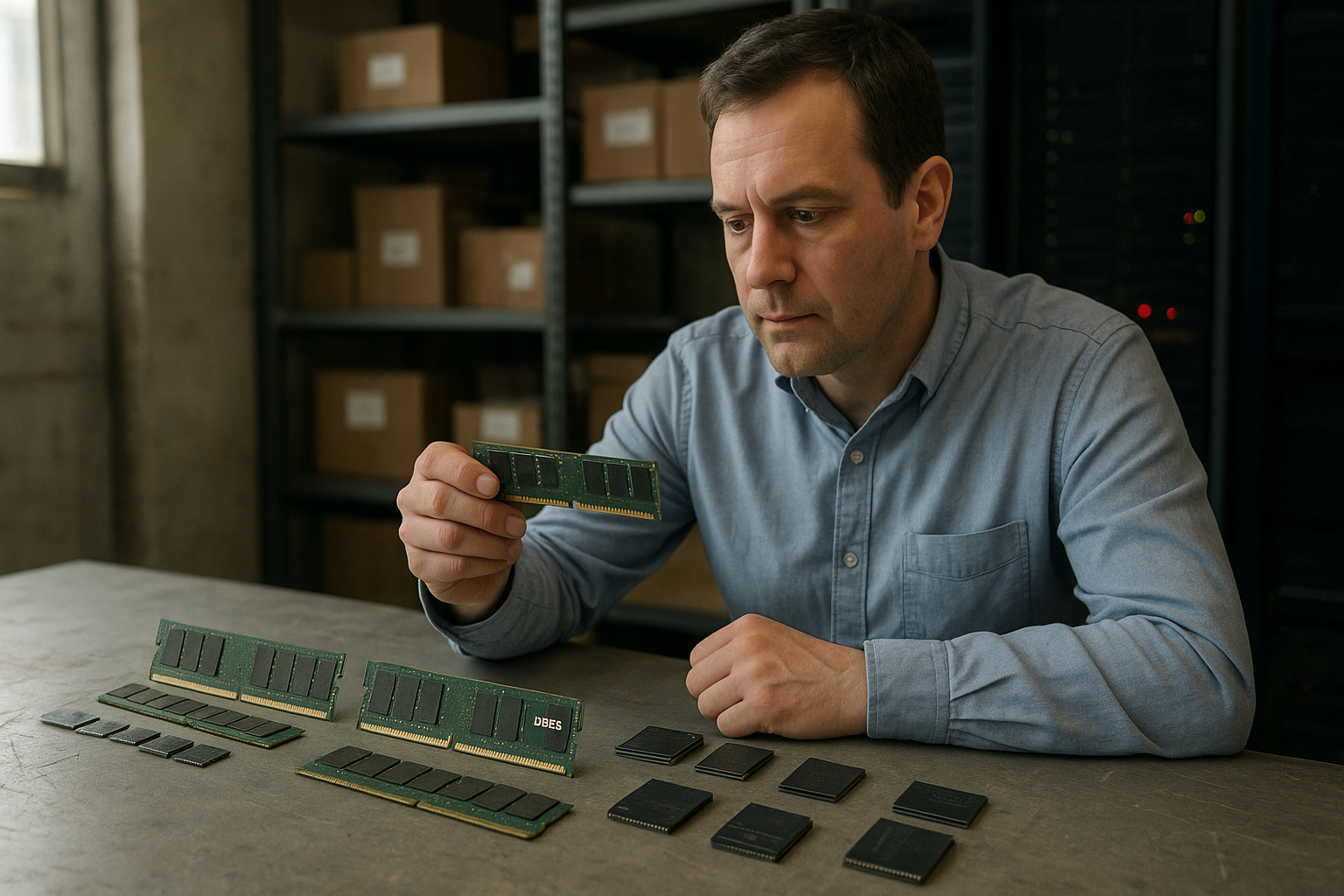
Memory market prices can stabilize without returning to their previous lows—and that distinction matters. Whether you are planning a PC upgrade, buying servers, or tracking the global memory market, a flatter price curve may signal that supply and demand are moving back into balance. It can also reflect weaker buying, reduced production, or customers postponing purchases.
This article explains what RAM price stabilization means, how DRAM and NAND markets differ, why DDR5 memory prices may behave differently from older standards, and which indicators offer a clearer picture than a single retail listing. It also outlines practical buying strategies for consumers, system builders, and IT departments.
Table of Contents
What Memory Price Stabilization Means
In market reporting, stabilization usually means prices are moving within a narrower range instead of rising or falling sharply. It does not necessarily mean memory has become inexpensive, nor does it guarantee that every capacity, speed, or region is following the same trend.
Memory market prices can stabilize at a high level after a period of inflation. They can also stabilize at a low level when manufacturers reduce output, distributors clear inventory, or customers delay orders. Whether the change feels positive to buyers depends on the market’s direction before stabilization.
Stable Does Not Mean Cheap
Consider two examples:
- High-price stabilization: wholesale quotations stop climbing, but the cost of a 32GB or 64GB kit remains elevated compared with the previous year.
- Low-price stabilization: prices stop falling because suppliers have cut production or buyers have absorbed excess stock.
Both situations qualify as stabilization, but their consequences differ for consumers and manufacturers. The first improves planning while keeping pressure on PC memory costs. The second may support future price increases if demand recovers before production expands again.
Spot Prices and Contract Prices
Memory has more than one price. Spot prices reflect shorter-term transactions, often involving available inventory. Contract prices are negotiated between suppliers and large customers over an agreed period. Retail prices then incorporate distribution, inventory, currency, tax, marketing, and retailer-margin effects.
These prices do not always move together. A spot-market decline may take time to reach a laptop manufacturer’s purchasing contract. Conversely, a retailer may discount old inventory even while new wholesale quotations are rising.
| Price signal | What it can show | What it cannot confirm by itself |
|---|---|---|
| Spot quotation | Short-term availability and trading pressure | The final retail price or long-term supplier profitability |
| Contract quotation | Negotiated pricing for large customers and planned supply | What a consumer will pay for a specific kit today |
| Retail price | Actual purchase cost for a particular product and region | Underlying chip pricing across the whole market |
| Company financial results | Revenue, margins, inventory, and management commentary | A precise price for a particular DRAM or NAND component |
For that reason, any serious assessment of memory market prices should combine several signals rather than rely on one online listing or weekly headline.
Why Memory Prices Change
Memory is a cyclical business. Manufacturers make large capital investments to produce standardized components, while buyers can often switch between suppliers when technology and qualification requirements allow it. Together, these conditions create periods of oversupply followed by tighter conditions.
When inventories build, buyers have less reason to place urgent orders. Suppliers may respond with lower quotations, production reductions, or delayed investment. When inventories become lean and demand improves, buyers compete for available output, pushing prices higher.
The Main Market Forces
- Production capacity: wafer starts, cleanroom availability, process transitions, and factory utilization affect the amount of memory that reaches the market.
- Inventory: supplier, distributor, PC-maker, and server-maker inventories influence how urgently customers need new shipments.
- Product mix: manufacturers may prioritize one memory generation or application over another when returns differ.
- End-market demand: PCs, smartphones, servers, graphics products, and industrial systems do not follow identical buying cycles.
- Capital expenditure: new facilities and process improvements can eventually add supply, but they require time and substantial investment.
- Macroeconomic conditions: interest rates, business spending, consumer confidence, and currency movements affect equipment purchases and retail pricing.
Manufacturing transitions can also create temporary friction. A supplier moving to a newer process may improve efficiency over time, yet output of a particular component or package can be constrained while production is qualified. The effect depends on the product and the supplier’s allocation decisions.
Why One Memory Type Can Rise While Another Falls
“Memory” covers several product families. DRAM provides working memory for PCs, phones, servers, and many other systems. NAND flash stores data in SSDs, memory cards, and embedded storage. Their manufacturing economics overlap in some areas, but their demand drivers and product inventories differ.
Even within DRAM, standard PC modules, mobile memory, graphics-oriented products, and server memory can face different conditions. A shortage in one segment does not automatically raise every memory product by the same amount.
That is why broad statements about the global memory market require careful qualification. A report about server components may not predict the next retail movement for a mainstream desktop kit.
DRAM and DDR5 Price Trends
DRAM price trends reflect both the overall memory cycle and the transition between generations. DDR5 is newer than DDR4 and introduces changes in bandwidth, module design, power management, and platform compatibility. Those differences affect manufacturing, validation, and the cost of the complete platform—not just the memory chips.
DDR5 memory prices can vary significantly by capacity, speed rating, latency, module configuration, and whether error-correcting features are included. A high-speed enthusiast kit and a basic desktop module should not be treated as the same market product.
How DDR5 Prices Can Stabilize
DDR5 pricing can become more predictable as production volumes increase, compatible processors and motherboards become widespread, and suppliers gain experience with the product mix. Retail competition may then narrow the gap between entry-level and mainstream modules.
However, stabilization does not eliminate platform costs. A buyer moving from DDR4 to DDR5 may also need a new motherboard and, depending on the upgrade, a new processor. The total upgrade bill can therefore remain high even if the memory module itself becomes less expensive.
DDR5 memory prices also respond to demand from systems that value higher bandwidth. If suppliers allocate more output toward enterprise or specialized products, consumer availability may not track the broader DRAM market perfectly.
DDR4 Versus DDR5: The Buying Context
| Consideration | DDR4 platform | DDR5 platform |
|---|---|---|
| Best fit | Existing compatible systems and lower-cost upgrades | Newer platform builds and users seeking current-generation support |
| Upgrade flexibility | Limited by older motherboard and processor compatibility | Depends on the chosen platform; DDR5 is not interchangeable with DDR4 |
| Price question | Module price may be attractive, but older-platform availability matters | Module price must be considered with motherboard and processor costs |
| Useful comparison | Compare like-for-like capacity and speed within DDR4 | Compare capacity, speed, latency, and platform support within DDR5 |
The practical lesson is straightforward: do not buy solely because a particular generation is cheaper per gigabyte. Check the system’s supported memory type, the workload, and the cost of the entire upgrade.
Memory Supply, Demand, and Semiconductor Cycles
The relationship between memory chip supply and demand explains why apparently good news can have mixed effects. If demand strengthens while inventories are already low, prices may rise quickly. If demand weakens while suppliers continue producing at a high rate, prices may fall even when factories are operating efficiently.
Stability becomes more durable when supply and demand remain balanced over several quarters rather than one short buying cycle. Signs of a healthier balance may include more disciplined production, less excess inventory, and customer orders that align with actual consumption instead of precautionary stockpiling.
Server Memory Demand and AI Infrastructure
Server memory demand can have an outsized effect because enterprise systems use large memory configurations and buyers often plan deployments in batches. Cloud expansion, database workloads, virtualization, and accelerated computing can all change the mix of memory products that suppliers prioritize.
Demand from data centers does not automatically translate into higher prices for every consumer module. Server products may have different specifications, qualification processes, packaging, and purchasing agreements. Still, strong enterprise demand can influence supplier capacity allocation and the overall balance of DRAM output.
Buyers should therefore distinguish between ordinary server DIMMs, high-capacity modules, and specialized memory associated with particular computing architectures. Headlines about infrastructure demand may be directionally useful without providing a direct forecast for a home PC upgrade.
The Role of Inventory
Inventory is one of the most useful concepts for understanding semiconductor pricing trends. Suppliers may report inventory in financial filings, while industry analysts and customers assess channel inventory through shipments, sell-through, and order patterns.
High inventory can delay a recovery. Customers may use existing stock before returning to the market, and suppliers may discount products to improve turnover. Low inventory can support pricing power, but it can also reflect weak production rather than healthy demand.
For an authoritative company-level perspective, readers can review supplier disclosures such as Micron’s annual reports and financial information. These documents do not provide a universal price list, but they help explain revenue, inventory, capital spending, and management’s description of market conditions.
Who Benefits From Stable Prices?
Price stability benefits more than shoppers looking for a discount. It improves planning for manufacturers, system integrators, cloud operators, and retailers by reducing exposure to sudden component-cost changes.
Consumers and PC Builders
Consumers can compare products based on capacity, compatibility, and performance instead of feeling pressured to buy immediately. Stable pricing also makes it easier to wait for a promotion without worrying that a short-term supply shock will erase the savings.
However, stable prices can reduce the chance of dramatic bargains. When retailers no longer need to clear excess stock, discounts may become less frequent or apply only to unusual configurations.
PC Makers and System Integrators
Predictable input costs help PC makers set product prices and plan configurations. The benefit is particularly important for systems sold through long product cycles, when a sudden change in component costs can affect margins or force specification changes.
System builders still need to manage currency risk, logistics, processor prices, storage costs, and demand forecasts. RAM price stabilization addresses only one part of the bill of materials.
Data Centers and IT Departments
Organizations buying memory at scale benefit from clearer procurement budgets and fewer surprises between project approval and deployment. Stable quotations can also simplify phased upgrades, although enterprise buyers must account for validation, support contracts, and the cost of downtime.
For servers, the lowest module price is rarely the only criterion. Capacity per system, reliability requirements, platform qualification, warranty terms, and power consumption can matter more than a small difference in unit price.
How to Read Memory Market Signals
News reports often use broad phrases such as “prices are recovering,” “the market has bottomed,” or “demand is improving.” Those phrases may describe a specific product, region, or time period rather than the entire industry.
Before drawing a conclusion about memory market prices, ask five questions:
- Which product? Is the report discussing PC DRAM, server DRAM, mobile memory, graphics memory, or NAND?
- Which price? Does it refer to spot, contract, wholesale, or retail pricing?
- Which region? Currency, taxes, shipping, and local inventory can produce different retail results.
- Which time frame? A weekly change may be noise, while a multi-quarter pattern is more meaningful.
- What is driving the move? Is it real end-user demand, inventory correction, production discipline, or a temporary allocation change?
Industry organizations can provide useful context without replacing product-level research. The World Semiconductor Trade Statistics publishes broader semiconductor market information, while the JEDEC standards organization provides technical standards and terminology relevant to memory products. Neither source should be treated as a live retail-price tracker.
A Retail Checklist for Memory Prices
When comparing a memory purchase, record the complete specification rather than focusing on the headline capacity:
- Memory generation, such as DDR4 or DDR5
- Total capacity and the number of modules
- Advertised data rate and timings
- Compatibility with the motherboard or server platform
- Warranty and return policy
- Retailer reputation and whether the product is new, open-box, or refurbished
A cheaper kit may use a less common configuration, have slower timings, or be unsuitable for the intended system. The most useful price comparison is between products that can perform the same job on the same platform.
Buying Advice by Use Case
When to Buy PC Memory
Buy when the upgrade addresses a current limitation and the module is compatible at a reasonable total cost. Waiting solely for the perfect bottom is difficult because retail prices can change for reasons unrelated to chip quotations, including promotions, exchange rates, and local inventory.
For a routine desktop upgrade, capacity and compatibility usually matter more than a small difference in rated speed. If the system is already adequate, a stable market supports waiting for a sale rather than rushing into a purchase.
When to Buy for a New PC Build
Choose the processor and motherboard first, then select memory supported by that platform. This prevents you from buying an inexpensive module that cannot be used after a change in motherboard generation.
For gaming and general productivity, compare complete kits at the capacity you actually need. A larger capacity can be more useful than a premium speed rating if the workload regularly approaches the system’s memory limit.
When to Buy for Servers
Server purchasing should begin with the platform’s qualified memory list and the workload’s capacity requirement. A low consumer retail quote is not a substitute for a supported enterprise component.
IT teams should also separate the cost of initial memory from the cost of future expansion. A platform with limited upgrade paths may require a larger initial purchase, while an expandable system can justify a staged procurement strategy if supply remains dependable.
Who Should Avoid Waiting
Waiting for lower memory market prices may be a poor choice when an upgrade is blocking work, a server deployment has a committed deadline, or an unusually good compatible offer is already available. The cost of lost productivity or delayed capacity can exceed a modest component saving.
On the other hand, buyers with no immediate need should not treat every market headline as a reason to purchase. Stabilization creates room to compare, verify compatibility, and buy based on actual requirements.
Limitations of Price Forecasts
No forecast can eliminate uncertainty from a cyclical component market. Public information often arrives after suppliers and large customers have already adjusted their orders, and different sources may measure different products or transaction types.
Forecasts can also miss changes in production plans, platform adoption, economic conditions, or customer inventory. A projection that is reasonable for server DRAM may be unhelpful for a consumer buying a two-module desktop kit.
Use forecasts as scenarios rather than promises. A sensible report should explain what would cause prices to rise, remain stable, or fall, and identify the time frame and product category being discussed.
Key Takeaways
- Memory market prices can stabilize at either a high or low level; stability does not automatically mean affordability.
- Spot, contract, wholesale, and retail prices measure different parts of the supply chain.
- DRAM price trends vary by product category, generation, region, and customer segment.
- DDR5 memory prices should be judged alongside motherboard and processor costs, not in isolation.
- Server memory demand can influence supplier allocation without directly predicting consumer RAM prices.
- Inventory, production discipline, and real end-market consumption are more useful signals than a single retail listing.
- Buyers should compare compatible products and the total cost of waiting, not just the advertised price per gigabyte.
Frequently Asked Questions
What does memory market prices stabilizing mean?
It means quotations are moving within a narrower range after a period of significant increases or decreases. Stabilization does not indicate that memory is cheap, nor does it mean every product has stopped changing price. The result may reflect balanced supply and demand, lower purchasing activity, production cuts, or a temporary inventory adjustment. Always check whether the report concerns DRAM or NAND and whether it refers to spot, contract, wholesale, or retail pricing.
Will RAM price stabilization make PC upgrades cheaper?
It may make budgeting easier, but it does not guarantee lower upgrade costs. Retail prices also depend on capacity, speed, currency, taxes, retailer inventory, and promotions. If prices stabilize above their previous low, the upgrade may remain expensive even though the market is no longer rising quickly. Compare compatible modules over time and consider whether the upgrade addresses a real performance or capacity problem.
Are DDR5 memory prices expected to follow DDR4 prices?
Not necessarily. DDR4 and DDR5 have different production mixes, platform requirements, demand patterns, and inventory conditions. DDR5 adoption can improve with newer processors and motherboards, while DDR4 can become less central to supplier product plans. The two generations may move in related ways because they share broader DRAM-cycle pressures, but they should not be assumed to have identical pricing or availability.
Why can server memory demand affect the wider DRAM market?
Servers often use large memory configurations, and cloud or enterprise deployments can involve substantial, planned purchases. Strong server demand may influence how suppliers allocate capacity among products. However, server memory has its own specifications, qualification requirements, and purchasing channels. A report about rising server demand is therefore a market signal, not a direct prediction of the price of a consumer desktop kit.
Should I wait for memory market prices to fall before buying?
Wait if the upgrade is optional and your system already meets your needs. If a compatible product is reasonably priced and the memory is required for work, a server deployment, or a time-sensitive build, the cost of delay may be greater than a possible future saving. Set a target price, monitor comparable products, and include shipping, taxes, and platform costs in the decision.
What is the best way to track DRAM price trends?
Use several types of information: reputable market reporting, supplier financial disclosures, inventory commentary, and actual retail listings for the exact product category you plan to buy. Separate short-term spot movement from contract pricing and longer-term sales data. Also check the date, region, currency, and memory type. No single public indicator captures the entire DRAM market or predicts a specific retail price with certainty.
Conclusion
Stable memory market prices make purchasing and production plans more predictable, but stabilization is not the same as a return to bargain pricing. The underlying picture depends on inventory, manufacturing discipline, product mix, and demand from PCs, mobile devices, servers, and other systems.
Before buying, identify the exact memory type your platform supports, compare like-for-like products, and consider the total cost of waiting. That approach is more reliable than reacting to a headline about the global memory market or assuming that a broad DRAM trend applies equally to every DDR4, DDR5, or server module.