
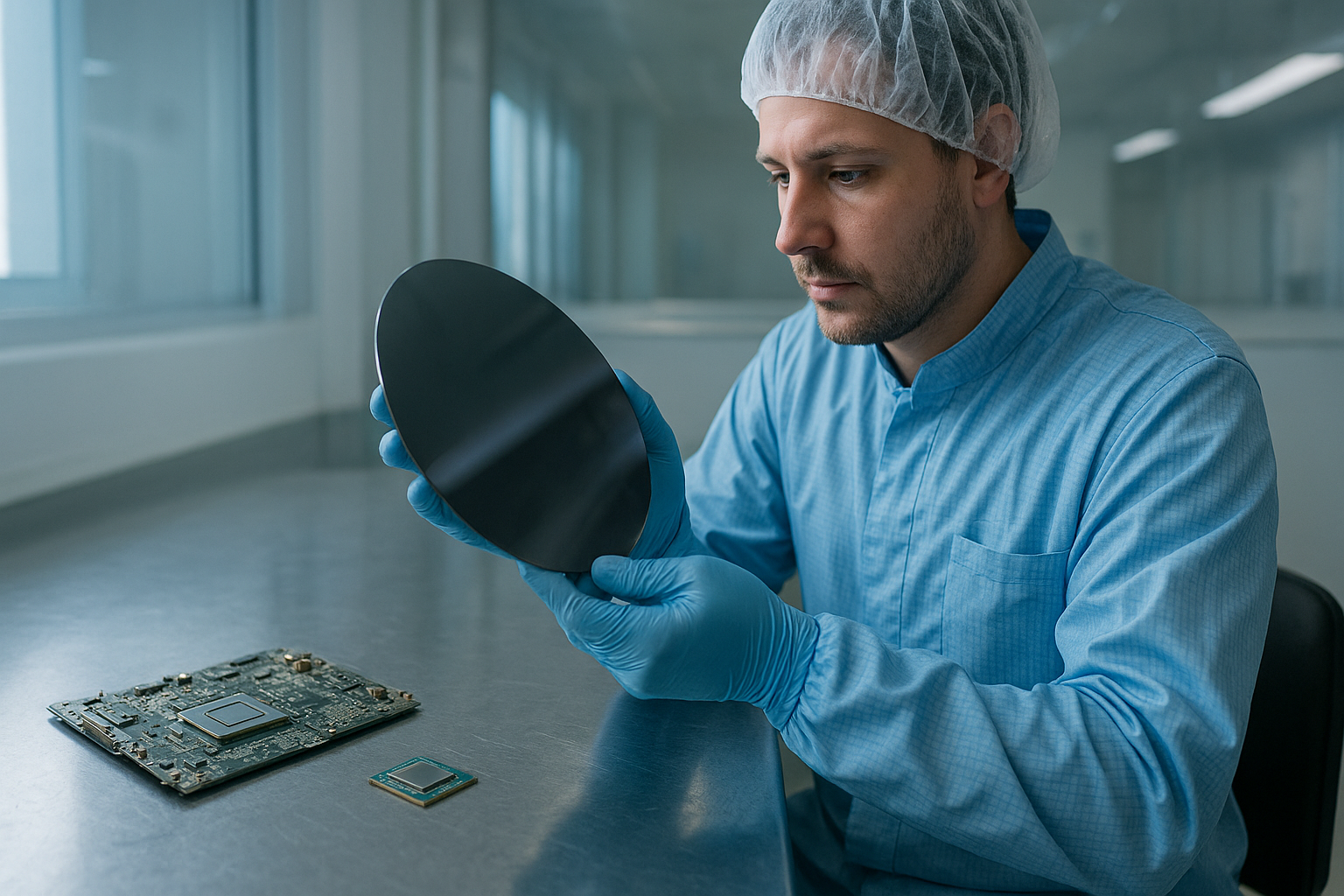
Intel Panther Lake is the company’s next major client-processor platform built around Intel’s 18A manufacturing process. The platform matters because it connects three parts of Intel’s recovery plan: a new process node, a new generation of PC chips, and a broader push to compete on efficiency as well as peak performance.
This guide explains what the Panther Lake interview and Intel’s public roadmap actually establish, what remains unconfirmed, and what the platform could mean for laptops, desktops, battery life, integrated graphics, and future Intel PCs. It also separates manufacturing claims from product specifications that Intel has not yet disclosed.
Table of Contents
- What is Intel Panther Lake?
- Where Panther Lake fits in the Intel 18A roadmap
- What the Panther Lake interview reveals
- Panther Lake and Intel’s PC strategy
- Performance, battery life, and graphics: what can be judged now
- How to compare Panther Lake with current Intel platforms
- Limitations and open questions
- Who should wait for Panther Lake?
- Key Takeaways
- Frequently Asked Questions
- Conclusion
What is Intel Panther Lake?
Panther Lake is the name Intel uses for a future generation of client processors. In practical terms, that means chips intended for consumer PCs, especially notebooks, rather than server CPUs or standalone graphics cards.
The platform is significant because it is associated with Intel 18A, the company’s next-generation process technology. Intel describes 18A as combining RibbonFET gate-all-around transistors with backside power delivery, which Intel calls PowerVia. These technologies are intended to improve transistor performance, power delivery, or both, but a process advantage does not automatically translate into a specific laptop battery-life result.
Intel has not treated the product name as a complete specification sheet. Panther Lake should therefore be understood as a platform and product family, not as one processor with one fixed core count, clock speed, graphics configuration, or thermal profile.
Why Panther Lake matters to Intel
Intel’s recent client strategy has increasingly used a mix of manufacturing technologies and chiplet-style designs. That approach lets the company combine different pieces of silicon, potentially matching each piece to a process that suits its function and cost.
Panther Lake is an important test of that strategy. It must demonstrate that Intel 18A can support a competitive product at meaningful volume while also delivering the efficiency, platform integration, and software experience expected from modern laptops.
For buyers, the most relevant question is not simply whether 18A is a newer node. The better question is whether Panther Lake systems offer a worthwhile improvement in the workloads people actually run: web applications, office software, video calls, content creation, gaming, and local AI features.
Where Panther Lake fits in the Intel 18A roadmap
The Intel 18A roadmap is a manufacturing and product roadmap rather than a promise that every 18A chip will arrive at the same time. Intel has positioned 18A as a key milestone for its own products and its foundry business, but manufacturing readiness, product qualification, customer systems, and retail availability are separate steps.
Intel 18A’s headline technologies are:
- RibbonFET: Intel’s gate-all-around transistor design, intended to provide more precise control of current through the transistor than earlier FinFET designs.
- PowerVia: a backside power-delivery approach that moves power connections away from the front side of the transistor circuitry.
- Advanced chip integration: the ability to combine multiple tiles or chiplets in a single package, using different manufacturing processes when appropriate.
These changes address different problems. RibbonFET concerns transistor construction, PowerVia concerns how power reaches the circuitry, and packaging determines how separate pieces communicate and share a physical package.
Intel’s public process information is useful for understanding the technology, but it cannot predict the final performance of a Panther Lake laptop. Laptop results depend on the chip configuration, cooling system, memory, firmware, display, battery capacity, and the manufacturer’s power limits.
Readers who want the process-level explanation should start with Intel’s official foundry process technology overview. It provides context for Intel’s node naming and process announcements without treating a manufacturing claim as a retail benchmark.
A roadmap is not the same as a release date
Roadmap language often includes terms such as “on track,” “in production,” or “planned.” Those terms do not necessarily mean that a finished laptop is available to buy. A product still needs validation, platform firmware, operating-system support, original-equipment-manufacturer design work, and a retail launch.
Unless Intel confirms a date for a specific model, it is safer to describe Panther Lake’s timing as planned or expected within the roadmap window discussed by the company. A precise launch date, processor lineup, or retail price should not be inferred from the process schedule alone.
What the Panther Lake interview reveals
The value of a Panther Lake interview is usually found in the priorities Intel executives and engineers emphasize, not in a single unannounced specification. Interview comments can clarify whether the company is focusing on manufacturing execution, client efficiency, AI capabilities, graphics, or a combination of those goals.
Three themes deserve attention when reading Intel’s statements about the platform.
Manufacturing execution is part of the product story
Intel has spent years rebuilding its process roadmap and expanding its foundry ambitions. That makes Panther Lake more than another entry in the Core processor family: it is also a public demonstration of whether Intel 18A can support a demanding client product.
Even a technically impressive design would have limited value if it could not be manufactured consistently, supplied in sufficient volume, and integrated into products from multiple PC makers. Yield, capacity, packaging, and validation are less visible than a benchmark score, but they determine whether buyers can actually find the resulting systems.
Efficiency is more than a smaller process
Intel’s messaging around future client chips increasingly reflects the importance of performance per watt. That matters most in thin laptops, where a manufacturer cannot simply increase cooling capacity to compensate for high power consumption.
However, “more efficient” can mean several different things. It might refer to longer battery life during light work, more performance within a fixed thermal limit, lower fan noise, faster completion of a short task, or reduced idle power. Reviews will need to test these separately.
Integration and AI remain platform concerns
Modern PC processors are judged as complete platforms. A CPU may include general-purpose cores, graphics, media engines, display support, memory controllers, and an AI accelerator. The balance between those blocks can matter more than the name of the manufacturing process for a particular user.
Intel has not publicly established every Panther Lake configuration in a complete retail lineup. Claims about exact neural-processing performance, integrated graphics speed, memory support, or core counts should therefore be treated cautiously until Intel publishes specifications and independent reviewers test shipping hardware.
Panther Lake and Intel’s PC strategy
Intel’s PC strategy now has to address a market in which customers compare processors from Intel, AMD, and Arm-based platforms on several dimensions at once. Raw multi-core performance still matters, but it competes with battery endurance, standby behavior, instant wake, video-call quality, graphics capability, and local AI features.
Panther Lake processors could help Intel present a more coherent answer to that competition if the platform combines strong single-threaded responsiveness with better sustained efficiency. That outcome depends on the final designs and the laptops built around them, not only on Intel 18A.
The laptop-first test
Laptops are likely to provide the clearest test of Intel’s next-generation approach. A notebook exposes weaknesses that a desktop can hide: inefficient idle behavior drains the battery, high sustained power creates heat, and poor graphics performance forces reliance on a discrete GPU.
A good Panther Lake laptop should be evaluated across several scenarios:
- Light productivity with a browser, documents, messaging, and video playback.
- Short bursts such as launching applications, compiling code, or exporting a small project.
- Long workloads such as video encoding, software builds, or 3D rendering.
- Sleep, standby, and modern connected standby behavior.
- Gaming and GPU-accelerated creative applications.
- Video conferencing with the display brightness and camera features enabled.
These tests reveal whether the platform is efficient only in ideal conditions or remains competitive when the system is busy for an extended period.
Desktop and workstation implications
A client platform can use the same architectural ideas across different power envelopes, but a desktop version should not be assumed to behave like a laptop version. Desktop systems have more cooling headroom, different motherboard requirements, and less dependence on battery performance.
For buyers planning a desktop upgrade, the important details will be socket or platform compatibility, memory support, expansion options, integrated graphics capability, and independent application benchmarks. Intel’s process milestone alone is not a reason to replace a functioning desktop.
Performance, battery life, and graphics: what can be judged now
There is not enough public information to assign Panther Lake a reliable benchmark position against a specific AMD, Apple, Qualcomm, or previous-generation Intel processor. Any article that gives exact performance percentages without identifying a verified configuration and test method is making a forecast, not reporting a result.
The same caution applies to Panther Lake battery life. Battery endurance belongs to the complete laptop. Two systems using the same processor can produce very different results because of display resolution, panel technology, battery size, cooling policy, firmware, background applications, and wireless settings.
| Area to evaluate | What the processor can influence | What the laptop maker also controls |
|---|---|---|
| Light-use battery life | Idle power, low-load efficiency, power-state transitions | Display, battery capacity, firmware, wireless hardware, background software |
| Sustained performance | Architecture, core configuration, power efficiency, memory behavior | Cooling system, chassis size, fan profile, long-term power limit |
| Gaming and graphics | Integrated GPU design, media engines, driver quality | Memory configuration, display, game settings, discrete GPU choice |
| AI workloads | Neural accelerator, CPU and GPU support, software drivers | Application support, operating system, model size, privacy settings |
| Responsiveness | Single-thread performance, latency, boost behavior | Storage, memory capacity, thermals, preinstalled software |
How to read Panther Lake battery-life claims
Look for the test conditions before accepting a battery-life number. A useful review should state the display brightness, resolution, browser or application workload, network settings, operating-system version, battery capacity, and whether the result came from a manufacturer utility or an independent test.
Claims based on “up to” figures are especially limited. They can show the best-case potential of a carefully configured system, but they do not describe the expected endurance of every Panther Lake notebook.
Integrated graphics and media workloads
Integrated graphics are increasingly important because many thin laptops do not include a separate GPU. Buyers should look for independent tests in the applications they use rather than relying on a general statement that the graphics engine is faster.
For video work, hardware decode and encode support can matter as much as 3D performance. A laptop that handles a particular codec efficiently may feel faster and use less power than one with a higher theoretical graphics score but weaker support in the user’s preferred software.
How to compare Panther Lake with current Intel platforms
The right comparison depends on the reason for buying. Someone replacing an eight-year-old laptop has a different baseline from someone deciding between two current premium notebooks.
| Buyer situation | What to compare | Practical recommendation |
|---|---|---|
| Older laptop with weak battery or slow storage | Whole-system responsiveness, display, battery, repairability | Buy a well-reviewed current system if it meets your needs; waiting is optional. |
| Current premium laptop that already performs well | Real battery endurance, noise, graphics, and application speed | Wait for independent Panther Lake reviews unless you need a specific feature now. |
| Content creator or developer | Sustained performance, memory capacity, cooling, software compatibility | Do not choose on process branding alone; prioritize tested workloads. |
| Gaming laptop buyer | Discrete GPU, cooling, display, CPU performance, game benchmarks | Evaluate the complete system. The processor name is only one part of gaming performance. |
| Desktop upgrader | Platform cost, motherboard, memory, expansion, upgrade path | Wait for confirmed platform specifications and independent value comparisons. |
This comparison also prevents a common mistake: treating a future processor as automatically better value than an available one. A current laptop with a lower price, larger battery, or better cooling may be the better purchase even if Panther Lake is technologically newer.
Limitations and open questions
The public Intel chip roadmap provides direction, but it does not answer every question buyers will have. Several details should remain open until Intel and PC manufacturers publish complete product information.
- Exact model range: the final names, core configurations, and power classes may vary by product segment.
- Retail timing: a roadmap window is not confirmation that every region will receive systems at the same time.
- Performance: independent benchmarks are needed to establish gains over current processors.
- Battery endurance: processor efficiency must be tested in finished laptops with representative displays and batteries.
- Graphics capability: integrated GPU performance and driver maturity require application and gaming tests.
- AI software: hardware acceleration is useful only when applications and operating systems support it.
- Pricing and availability: these depend heavily on PC manufacturers and regional configurations.
What would count as success?
For Intel, success would not be limited to producing a chip on 18A. The stronger test is whether the resulting PCs are competitive as products: available in credible designs, efficient during ordinary use, fast under sustained workloads, and supported by stable graphics and AI software.
For consumers, a successful launch would offer meaningful choices rather than one heavily restricted flagship model. Broad availability across thin-and-light, performance, and business laptops would make the roadmap more relevant than a single impressive demonstration system.
Who should wait for Panther Lake?
Waiting makes the most sense for buyers whose current laptop still works and who care about efficiency, integrated graphics, or a new platform with longer support potential. It is also sensible for enthusiasts who want to compare independent reviews before choosing between Intel, AMD, and Arm-based Windows systems.
Buyers who need a computer immediately should not delay solely because Panther Lake is on the roadmap. Current systems can already offer strong performance, and launch products may carry a price premium or have limited configuration choices.
Who should avoid buying on rumors?
Avoid making a purchase based on an unverified core count, clock speed, battery figure, benchmark leak, or retailer listing. Early information can describe an engineering sample, a different power class, or a configuration that never reaches stores.
When Panther Lake systems become available, compare the exact laptop model rather than the platform label. Check memory configuration, storage, display, battery size, warranty, ports, fan noise, and independent test results.
Key Takeaways
- Intel Panther Lake is a future client-PC processor family associated with Intel 18A.
- Intel 18A combines RibbonFET transistors and PowerVia backside power delivery, but process features do not guarantee a particular laptop result.
- The platform is strategically important because it tests Intel’s manufacturing recovery and its efficiency-focused PC strategy.
- Exact specifications, pricing, retail availability, and benchmark performance should not be assumed until Intel and PC makers confirm them.
- Panther Lake battery life will depend on the complete laptop, including its screen, battery, cooling, firmware, and software.
- Buyers should compare finished systems and tested workloads instead of choosing solely by processor generation.
- If your current computer meets your needs, waiting for independent Panther Lake reviews is reasonable; if you need a system now, a well-reviewed current model may offer better value.
Frequently Asked Questions
What is Panther Lake?
Panther Lake is Intel’s name for a future generation of client processors designed for personal computers. It is associated with Intel 18A, the company’s next-generation process technology. Panther Lake should not be treated as one single chip with one specification: the eventual family may cover multiple configurations and power classes. Intel has not publicly confirmed every retail model, specification, price, or regional launch detail.
Why is Intel 18A important for Panther Lake?
Intel 18A is intended to introduce RibbonFET gate-all-around transistors and PowerVia backside power delivery. These technologies aim to improve transistor control and power-delivery efficiency at the process level. Their real consumer impact will depend on the final chip design and the computer surrounding it. A newer process can provide opportunities, but independent testing is still required to establish actual performance and battery-life gains.
When will Panther Lake processors be available?
Availability should be described according to Intel’s latest confirmed product announcements rather than inferred from an early roadmap. A process milestone or “on track” statement does not necessarily mean that retail laptops are shipping. Launch timing can differ by product category and region. Check Intel’s official newsroom and PC manufacturer announcements for confirmed models, then verify that the specific configuration is available in your market.
Will Panther Lake improve laptop battery life?
It may improve efficiency, but no universal battery-life result can be promised from the processor name alone. Endurance depends on the display, battery capacity, firmware, cooling, wireless hardware, background applications, and operating system. Reviews should test light productivity, video playback, standby, and sustained workloads. A Panther Lake laptop with a high-resolution display may last less time than a less demanding laptop using a different configuration.
Will Panther Lake be faster than current Intel processors?
The platform is designed as a newer generation, but exact gains depend on the model and workload. Short, lightly threaded tasks, multi-core work, graphics, and AI applications can show different results. Until independent reviews test shipping systems, precise performance comparisons remain unverified. Buyers should wait for benchmarks that identify the processor, power limits, memory, cooling system, and software version.
Is Panther Lake intended for laptops or desktops?
Panther Lake is primarily discussed as a client-PC platform, with laptops likely to be a major focus. That does not by itself confirm the complete desktop lineup or its specifications. Laptop and desktop versions can have different power limits, packaging, memory support, and motherboard requirements. Desktop buyers should wait for confirmed platform details rather than assuming that a laptop-oriented product will translate directly to a desktop upgrade.
Should I buy a current PC or wait for Panther Lake?
Buy now if you need a reliable computer, find a suitable current model at a good price, or have a workload that today’s systems already handle well. Waiting is reasonable if your current machine works and you specifically want to compare Intel’s 18A generation with competing platforms. In either case, evaluate the complete system: battery, screen, keyboard, cooling, memory, storage, repair options, and tested performance matter as much as the processor family.
Conclusion
Intel Panther Lake is important because it links Intel’s 18A manufacturing plans with its attempt to build more efficient, competitive PCs. The most credible reading of the roadmap is promising but measured: Panther Lake may give Intel a stronger technical foundation, yet the buying decision will depend on real laptops, confirmed specifications, software support, pricing, and independent tests.
If you are shopping now, compare available systems on their actual battery and performance behavior rather than waiting indefinitely for a roadmap product. If your current PC is adequate, monitor Intel’s official announcements and wait for reviews of shipping Panther Lake models before deciding whether the 18A platform delivers a meaningful improvement for your workloads.