
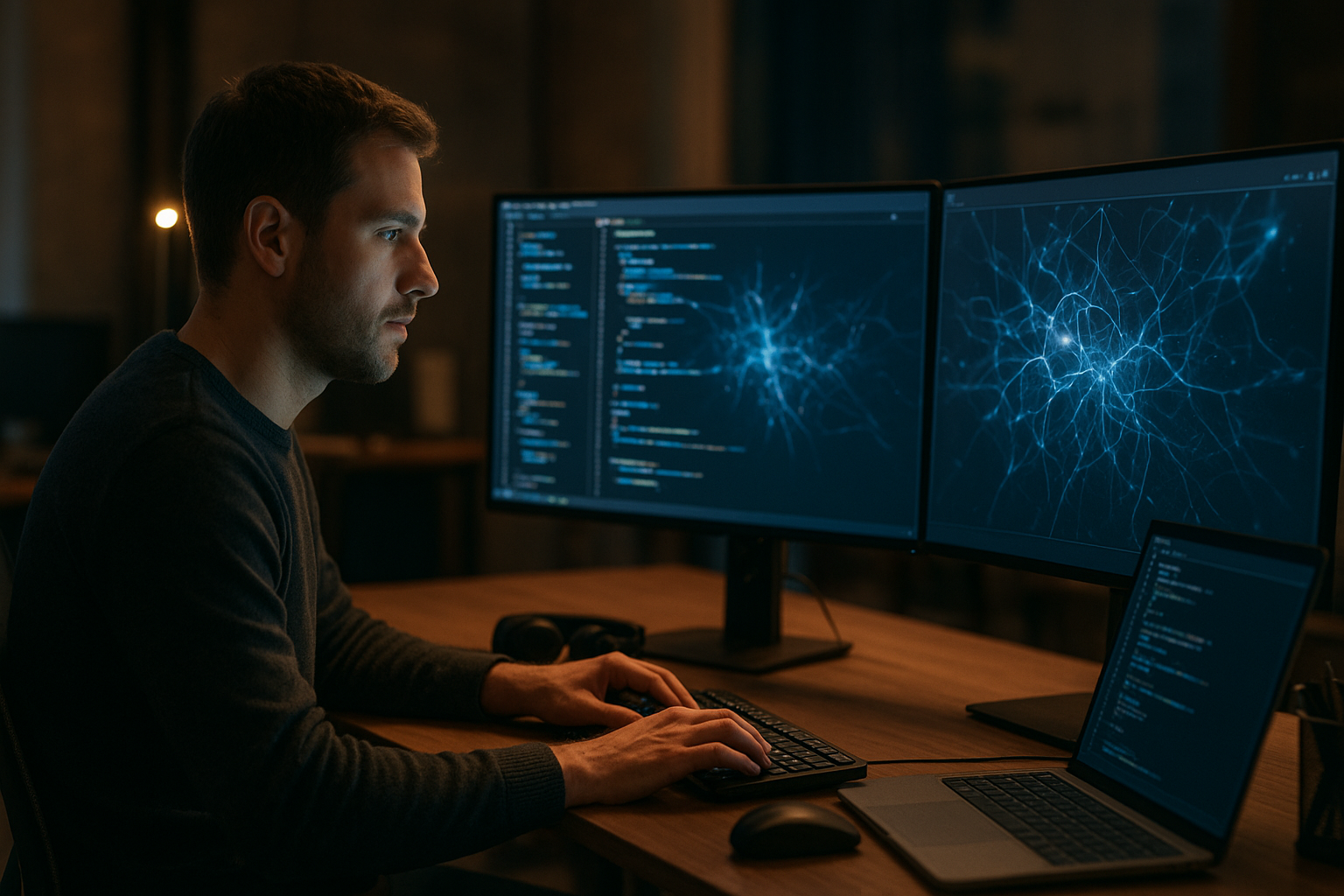
AI coding assistants are moving beyond autocomplete. By 2027, the most useful systems may plan projects, test changes, explain trade-offs and coordinate routine work across the software lifecycle. These predictions are not promises or product announcements; they are informed scenarios based on current progress in AI coding tools, developer workflows and software engineering research.
Table of Contents
Five predictions for AI coding assistants
1. From suggestions to software ownership
Today, many AI programming assistants respond to a prompt or complete a small block of code. By 2027, more products could accept a defined goal, divide it into tasks, make changes across a repository and report what still needs human attention.
That does not mean developers will disappear. Instead, autonomous coding agents may handle repetitive implementation while people set boundaries, review important decisions and approve production changes. The strongest systems will be judged by the quality of their reasoning and verification, not by the number of lines they generate.
2. Planning will become a central feature
Future AI software development platforms are likely to spend more time understanding an application before editing it. An assistant may map dependencies, identify affected services, compare possible approaches and produce a proposed sequence of work before writing code.
This planning layer could make developer AI tools more valuable for large codebases, where a fast but poorly targeted edit can create more work than it saves. Teams will still need clear requirements and human review, particularly for security-sensitive or business-critical systems.
3. Testing and maintenance will move closer to the editor
One of the most practical developments in the future of AI coding may be continuous assistance after a feature is merged. Coding assistants in 2027 could suggest missing tests, explain failing builds, identify suspicious changes and prepare maintenance patches for review.
These capabilities will be most useful when connected to reliable project context. An assistant that can see test results, documentation and version history may offer better guidance than one operating from a short prompt alone. Even then, generated fixes should be tested rather than accepted automatically.
4. Natural-language interfaces will become more specialised
General chat is unlikely to be the only way developers interact with AI coding tools. Expect more focused controls for database changes, interface design, infrastructure, debugging and code review. Voice, diagrams and structured forms may complement conventional prompts.
Specialisation could reduce ambiguity. Rather than asking an assistant to “make the app faster,” a developer might select a performance goal, identify the relevant service and request a measured proposal. The result should be a more predictable workflow, although it may require better documentation and team conventions.
5. Governance will become part of the product
As AI coding assistants gain broader permissions, organisations will need controls for access, audit trails, data handling and approval. Enterprise buyers may care as much about visibility and policy enforcement as they do about generation quality.
In practice, the most trusted autonomous coding agents may be those that clearly show which files they changed, which tools they used and what evidence supports their recommendation. Human accountability will remain essential when software affects customers, finances or safety.
How the developer experience may change
| Current pattern | Possible 2027 pattern | Human responsibility |
|---|---|---|
| Request a code snippet | Describe a goal and review a proposed implementation plan | Define scope and constraints |
| Run tests manually | Receive continuous test and risk suggestions | Validate evidence and approve fixes |
| Search documentation separately | Ask for context-aware explanations inside the workspace | Check sources and project fit |
The key distinction is not whether machines write code. It is whether the surrounding process makes their work understandable, reversible and testable. Teams adopting AI software development practices should begin with low-risk tasks, establish review rules and measure outcomes that matter to their projects.
When the signal may weaken
AI systems can produce confident but incorrect answers, misunderstand unfamiliar code and follow outdated assumptions. A polished response is not proof that a design is safe, efficient or compatible with the rest of an application.
There are also organisational risks. If developers lose visibility into decisions made by automated systems, debugging and accountability can become harder. Training data, confidential repositories and third-party dependencies require careful handling, especially when tools connect to external services.
Readers tracking these developments can browse coverage of artificial intelligence, explore technology events and subscribe through the technology newsletter for future updates.
Editorial and transparency notes
About this publication
This article is an analytical forecast, not a claim about a specific company roadmap. Product capabilities, policies and developer practices can change before 2027, so readers should verify current information with official documentation before making purchasing or deployment decisions.
How this article was prepared
The discussion separates observable trends from predictions and avoids assigning unverified specifications, prices or performance figures to named products. The editorial goal is to help readers ask better questions about AI programming assistants rather than encourage unquestioned adoption.
Legal and reader clarity
Examples are illustrative and should not be treated as legal, security or engineering advice. Teams remain responsible for code review, licensing checks, privacy protection, testing and compliance. Transparency about uncertainty is especially important when discussing emerging technologies.
Key Takeaways
- AI coding assistants may evolve from autocomplete features into workflow partners.
- Planning, testing, maintenance and governance could become core capabilities.
- Autonomous coding agents will still require permissions, review and accountability.
- The best AI coding tools should make their actions and evidence easy to inspect.
- Developers can prepare by improving documentation, tests and approval processes.
Frequently Asked Questions
What are AI coding assistants?
They are software tools that use artificial intelligence to help with tasks such as generating, explaining, editing, testing or reviewing code.
What will coding assistants in 2027 do differently?
They may manage broader, multi-step tasks, including planning changes, coordinating tools and preparing work for human approval.
Will AI programming assistants replace developers?
Replacement is not a reliable prediction. These systems are more likely to change developer responsibilities, with greater emphasis on architecture, verification, security and product decisions.
Are autonomous coding agents safe to use?
Safety depends on permissions, testing, isolation, monitoring and human review. Organisations should begin with limited access and low-risk workflows.
How should a team prepare for AI software development?
Improve automated tests, documentation, code ownership and review policies. These foundations help people evaluate machine-generated changes more effectively.
What should buyers compare in AI coding tools?
Consider accuracy, repository context, privacy controls, integrations, auditability, cost and the quality of review workflows—not generation speed alone.
Preparing for the next generation
The future of AI coding will be shaped as much by engineering discipline as by model capability. AI coding assistants can reduce routine effort, but dependable results will come from clear goals, strong tests and informed human oversight.
Start now by selecting one contained workflow, documenting its risks and measuring whether an assistant improves delivery without weakening quality. That practical experiment is the clearest next step toward using AI coding assistants responsibly in 2027.