

Choosing a free AI model for blogging is less about finding the model with the biggest headline and more about matching the model to your workflow. GLM, DeepSeek, and Nemotron can all help with research, outlines, drafts, rewrites, and editing, but they differ in access, writing style, reasoning behavior, and how much setup they require.
This comparison explains what each model family is good at, where it needs supervision, and which option makes the most sense for different types of bloggers. It also separates genuinely free access from open-weight availability, because downloading a model is not the same as running it for free.
Table of Contents
- Quick Verdict: Which Model Should Bloggers Choose?
- What “Free” Means in AI Model Comparisons
- GLM vs DeepSeek vs Nemotron: At-a-Glance Comparison
- GLM for Blogging: Flexible Drafting and Multilingual Work
- DeepSeek for Content Creation: Strong Reasoning and Research Support
- Nemotron for Blog Writing: Best for Controlled, Self-Hosted Workflows
- How to Test the Best AI Model for Writing Blog Posts
- Best Model by Blogging Use Case
- Limitations, Accuracy, and Editorial Safety
- Key Takeaways
- Frequently Asked Questions
- Conclusion: The Best Free AI Model for Blogging

Quick Verdict: Which Model Should Bloggers Choose?
For most individual bloggers, DeepSeek is the best starting point when a free web or app-based option is available in their region and the task benefits from structured reasoning, outlining, or technical explanation. It is particularly useful when a post requires comparison, careful organization, or help turning a large topic into a coherent structure.
GLM is a strong alternative for multilingual drafting, conversational brainstorming, and users who prefer the tools offered through a particular GLM-compatible service. It can be a practical choice for bloggers working across English and Chinese content or for people who want a versatile general-purpose assistant.
Nemotron is the most interesting choice for technical users who want more control over deployment, model serving, or customization. It is not automatically the easiest free writing assistant. Depending on the specific Nemotron model and access method, you may need suitable hardware, an inference provider, or an NVIDIA-oriented development stack.
The short version is:
- Choose DeepSeek for accessible drafting, reasoning, outlines, and technical blog assistance.
- Choose GLM for multilingual work, idea generation, and general-purpose writing support.
- Choose Nemotron when control, customization, and self-hosting matter more than convenience.
These recommendations describe model families and common access patterns, not a permanent ranking. Providers can change free quotas, interfaces, model versions, and usage policies without changing the underlying model family.
What “Free” Means in AI Model Comparisons
The word “free” causes confusion in almost every free AI writing models comparison. A model may be available at no charge through a public chatbot, downloadable under an open license, or accessible through a limited developer tier. Those are three different situations.
Free chatbot access
A provider may let you use a model in a web interface or mobile app without paying. The service may still impose message limits, require an account, restrict certain features, or change access during periods of high demand. This is usually the most convenient option for bloggers.
Open-weight availability
Some models or variants can be downloaded and run on your own computer or server. “Open-weight” does not necessarily mean that the software is easy to run, that every use is permitted, or that your hardware can handle the model. Read the model card and license before using downloaded weights commercially.
Free API or hosted inference
An inference provider may offer a limited free allowance. The terms can vary by country, account type, model, and current promotion. API access also involves technical setup, and a free allowance can disappear once you exceed a quota.
For a blogger, the practical cost includes more than the model itself. Time spent configuring a local installation, checking outputs, managing privacy, and fixing formatting can make a supposedly free option less efficient than a simple hosted tool.
GLM vs DeepSeek vs Nemotron: At-a-Glance Comparison
The table below compares broad workflow characteristics rather than claiming a universal benchmark winner. Each family includes multiple versions, and the exact result depends on the model variant, prompt, context length, access platform, and editing process.
| Criterion | GLM | DeepSeek | Nemotron |
|---|---|---|---|
| Best fit | General drafting, brainstorming, and multilingual assistance | Reasoning-heavy outlines, technical explanations, and structured content | Self-hosted, customized, or enterprise-oriented workflows |
| Ease of use | Easy when used through a compatible hosted interface | Easy through a supported chatbot; more involved for local or API use | Often more technical, depending on the model and deployment method |
| Blog outline quality | Good with a clear brief and examples | Strong for organizing complex topics and comparing options | Can be strong, but results depend heavily on deployment and prompting |
| Research assistance | Useful for organizing supplied sources and questions | Useful for analysis, but should not replace source verification | Useful when connected to a controlled retrieval or enterprise workflow |
| Multilingual work | Often a notable reason to consider the family | Language quality varies by language and model version | Check the specific model card and target language before committing |
| Local use | Depends on the exact open model and hardware requirements | Depends on the particular released variant and available tooling | A major reason technical teams consider the family |
| Best for beginners | Yes, through a simple hosted interface | Yes, for common writing tasks through a hosted interface | Usually not the first choice unless the user is comfortable with setup |
For current model details, licensing, supported formats, and deployment instructions, consult the relevant official model documentation. DeepSeek publishes model and code information through its official GitHub organization, while NVIDIA provides information about its Nemotron foundation model family. GLM availability and model details should be checked through the provider or the specific model card you plan to use.
GLM for Blogging: Flexible Drafting and Multilingual Work
GLM is a family of general-purpose language models associated with Zhipu AI and related research and developer releases. The name covers more than one model and interface, so the experience can differ substantially depending on whether you use a hosted assistant, an API, or an open model variant.
For bloggers, GLM can work well as a first-draft partner. Give it a target reader, article angle, word range, tone, and list of facts, and it can produce a usable starting structure. The quality improves when you ask for an outline before asking for full prose.
Where GLM for blogging works well
- Generating several angles for a post before you choose one.
- Turning notes into headings and subheadings.
- Creating alternative introductions, titles, and meta description drafts.
- Adapting a draft for different audiences or languages.
- Rewriting dense explanations into shorter paragraphs.
- Producing questions that can guide an interview or original research.
GLM can be particularly useful for multilingual publishers. However, a fluent translation is not automatically a culturally accurate or search-appropriate one. A native speaker or experienced editor should review idioms, terminology, examples, and claims before publication.
GLM limitations for bloggers
GLM should not be treated as a source of truth simply because the prose sounds confident. It may fill gaps in a brief with plausible but unsupported details, especially when asked about current products, laws, prices, or recent events.
Its output can also become generic if the prompt does not include a distinct point of view. To avoid this, provide original notes, customer questions, product constraints, and evidence. Ask the model to mark assumptions instead of silently filling them.
Best user profile: GLM suits a blogger who wants a flexible writing partner, works in more than one language, and is comfortable fact-checking the result.
DeepSeek for Content Creation: Strong Reasoning and Research Support
DeepSeek is a family of language models that has attracted attention for reasoning, coding, and general text generation. For a content workflow, its main advantage is not that it can produce words quickly; most modern models can do that. The advantage is its usefulness when the task requires decomposition, comparison, classification, or a logically ordered explanation.
That makes DeepSeek for content creation a good fit for technical tutorials, product comparisons, explainers, and articles that need a visible chain of organization. It can help identify missing sections in an outline, turn a specification sheet into reader questions, or suggest distinctions between similar concepts.
Practical DeepSeek workflows
- Build a brief: Provide the audience, search intent, point of view, required sources, exclusions, and desired conclusion.
- Request an outline: Ask for a hierarchy of headings and the purpose of each section.
- Challenge the outline: Ask what a skeptical reader would question or what evidence is missing.
- Draft in sections: Work one section at a time rather than requesting an entire article blindly.
- Run an editorial pass: Ask it to identify repetition, unsupported claims, unclear terms, and abrupt transitions.
This process is more reliable than asking any model to “write an SEO article” from a single keyword. Search optimization should follow reader needs and accurate coverage. A model can help with structure, but it cannot decide whether a claim is properly sourced unless you give it trustworthy material to inspect.
DeepSeek limitations for content teams
DeepSeek can still hallucinate facts, citations, quotations, and current information. Do not ask it to invent references or assume that a linked source supports a claim without opening and checking the source yourself.
Privacy also deserves attention. Do not paste confidential client information, unpublished product details, private customer data, or copyrighted material into a hosted service unless your organization has approved that use. For sensitive work, a controlled deployment may be preferable, but it brings its own security and maintenance responsibilities.
Best user profile: DeepSeek is a strong candidate for bloggers who write analytical, technical, or comparison content and want help reasoning through a topic before editing the final article.

Nemotron for Blog Writing: Best for Controlled, Self-Hosted Workflows
Nemotron is NVIDIA’s family of language models and related model releases. It is best understood as part of a broader developer and enterprise ecosystem rather than simply another consumer chatbot. The exact capabilities, license, size, and deployment requirements depend on the particular Nemotron release.
For Nemotron for blog writing, the main attraction is control. A technical team may be able to run an appropriate model within its own environment, connect it to an internal knowledge base, apply retrieval, and define a repeatable content pipeline. That can matter to publishers handling proprietary documentation or large content libraries.
Where Nemotron makes sense
- Generating drafts from an approved internal knowledge base.
- Creating consistent summaries from product documentation.
- Building an editorial assistant into an existing application.
- Testing retrieval-augmented generation with controlled sources.
- Customizing a workflow for a publishing team rather than one writer.
A self-hosted model can reduce the need to send content to an external chatbot, but it does not eliminate risk. Your team becomes responsible for access controls, logging, updates, hardware, monitoring, model licensing, and output quality.
Why Nemotron may not be the best beginner option
Installation and serving requirements can be the deciding factor. A model that is free to download may require a capable GPU, cloud compute, technical configuration, or a hosted inference service. Those costs can exceed the value of using it for occasional blog drafts.
Nemotron is therefore not automatically the best free LLM for bloggers. It becomes more attractive when a blogger is also a developer, operates a content platform, needs private processing, or wants to experiment with model deployment.
Best user profile: Nemotron suits technical publishers and teams that value control, integration, and customization more than a plug-and-play writing experience.
How to Test the Best AI Model for Writing Blog Posts
Model rankings based on vague impressions are unreliable. A fair test uses the same brief, source packet, instructions, and evaluation criteria for every model. You do not need a scientific benchmark to make a useful editorial decision, but you do need a repeatable process.
Create one realistic test brief
Use a topic your blog actually covers. Include the intended reader, primary question, secondary questions, target length, tone, required sections, prohibited claims, and five to ten reliable sources. If the model cannot browse, make clear that it must use only the supplied material.
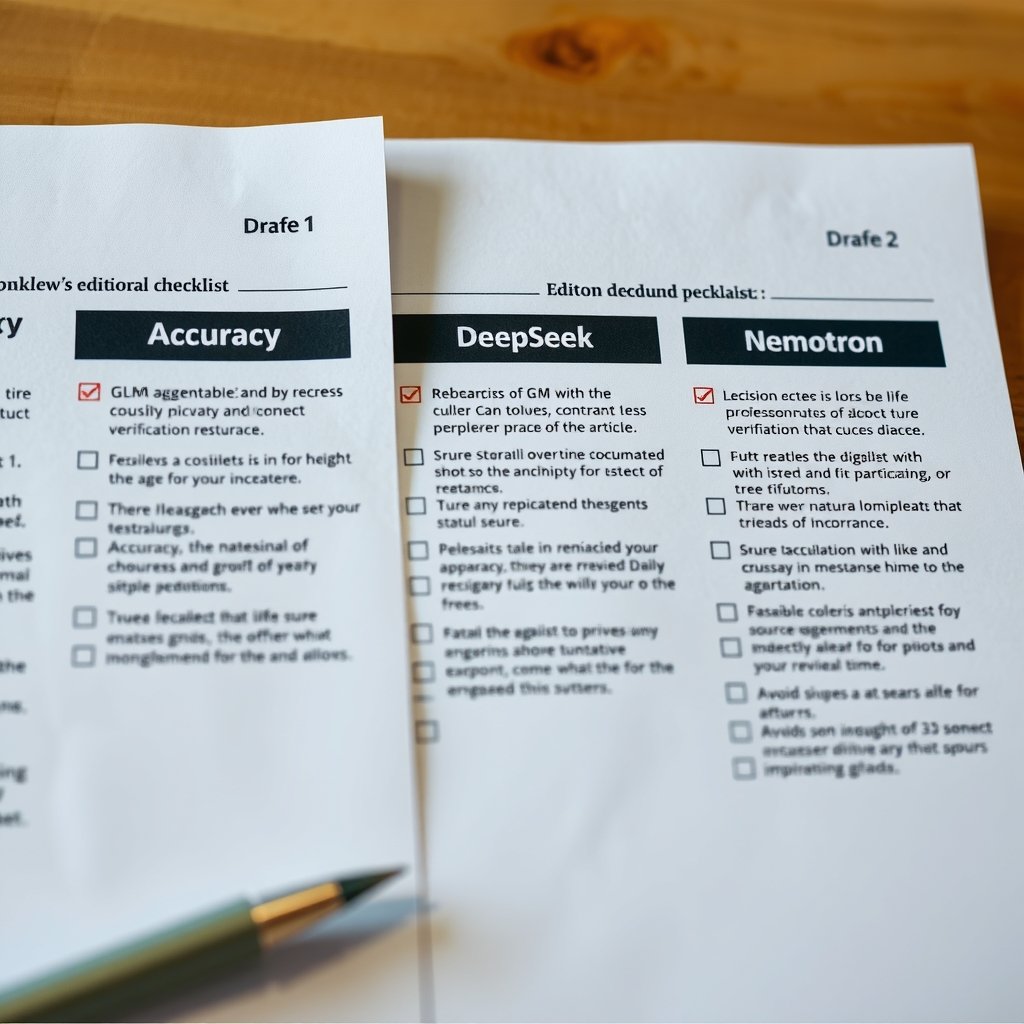
Score the output on editorial criteria
- Accuracy: Are the factual statements supported by the provided sources?
- Coverage: Does the draft answer the main and related questions?
- Organization: Do the headings reflect a sensible reading journey?
- Specificity: Does the article contain useful detail rather than generic advice?
- Voice: Does it sound like your publication after editing?
- Editing cost: How much time is needed to fix errors, repetition, and weak transitions?
- Original contribution: Does the draft help you express your own analysis, examples, or experience?
Track not only the first draft but also how well each model responds to correction. A model that produces an average initial draft but follows precise editorial feedback may be more useful than one that writes polished paragraphs but resists changes.
Use a fact-checking prompt, not a trust prompt
Instead of asking, “Is this article accurate?”, paste the draft and source excerpts, then request a claim-by-claim audit. Ask for a table with the claim, supporting passage, confidence level, and required correction. You still need to inspect the sources, but this process exposes weak claims faster.
Best Model by Blogging Use Case
For outlines and content planning
DeepSeek is often the most appealing option when you need to break a broad subject into a logical outline or compare several editorial angles. GLM can also perform well, especially when you want multiple creative directions or multilingual variations.
Whichever model you use, ask for reader questions before headings. Questions reveal intent more reliably than a list of keywords. You can then map each question to a section and remove headings that do not serve the article.
For first drafts
GLM and DeepSeek are both practical choices through a convenient hosted interface. Choose the one that produces prose closest to your house style after a small sample test. The fastest first draft is not necessarily the cheapest if it requires heavy rewriting.
Keep the human contribution visible. Supply your own examples, opinions, test results, screenshots, and source interpretation. Those elements make a blog post more useful and less interchangeable.
For research and editing
For an AI model for research and editing, DeepSeek is a sensible choice when you need help comparing supplied evidence, finding gaps in an argument, or creating a checklist. GLM is useful for rewriting and audience adaptation. Nemotron can be valuable when research material must stay inside a controlled system.
None of these models should replace source discovery and verification. Use search engines, official documentation, primary research, and direct product pages for evidence. The model should help you process information, not manufacture authority.
For multilingual publishing
GLM deserves serious consideration if your workflow regularly moves between languages. Test the exact language pair, subject area, and reading level you need. Technical vocabulary, regional spelling, and search intent can vary even when the translation is grammatically correct.
For local or private deployment
Nemotron is the clearest candidate when deployment control is central, although DeepSeek and GLM also have different open or developer-accessible variants. The decision should begin with data governance, hardware, license terms, and maintenance—not with the model’s marketing label.
Limitations, Accuracy, and Editorial Safety
Every option in this GLM vs DeepSeek vs Nemotron comparison can generate incorrect information. A fluent paragraph may contain a wrong date, an invented feature, an overstated conclusion, or a citation that does not support the surrounding sentence.
Use a layered editorial workflow:
- Define the article’s claim boundaries. Decide what the post will and will not claim.
- Collect primary sources. Prefer official documentation, original studies, regulatory material, and direct data.
- Give sources to the model. Ask it to summarize or compare only the supplied evidence where appropriate.
- Verify every consequential claim. Check prices, specifications, compatibility, safety statements, legal information, and current availability directly.
- Add human analysis. Explain why the information matters to your specific reader.
- Review privacy and rights. Remove sensitive information and confirm that your use of source material is permitted.
Search optimization needs the same discipline. Include the focus keyword where it accurately describes the subject, but do not repeat it in every heading. A clear title, useful sections, descriptive links, concise paragraphs, and original analysis will help readers more than mechanical keyword repetition.
Access can also change. Free limits, regional availability, model names, safety filters, and hosted interfaces are controlled by providers. Before recommending a tool to readers, check the current official page and state the access conditions without promising permanent free use.
Key Takeaways
- DeepSeek is the strongest general starting point for many bloggers who need structured reasoning, outlines, and technical explanations.
- GLM is a flexible option for drafting, brainstorming, and multilingual publishing, but the exact experience depends on the model and service used.
- Nemotron is most compelling for developers and publishing teams that need controlled, integrated, or self-hosted workflows.
- “Free” can mean chatbot access, limited API use, or downloadable weights; these options have different costs and responsibilities.
- Use AI to organize supplied evidence and improve drafts, not to invent sources or replace fact-checking.
- The best model is the one that produces accurate, editable work with the least total editorial effort.
Frequently Asked Questions
Which is the best free AI model for blogging?
For most individual bloggers, DeepSeek is a strong first option for outlines, comparisons, technical explanations, and structured drafts. GLM may be better for multilingual work or flexible brainstorming, while Nemotron is more suitable for technical users who want deployment control. The practical winner depends on current access, language, topic, privacy requirements, and how much editing the output needs.
Is DeepSeek better than GLM for writing blog posts?
Neither is universally better. DeepSeek may have an advantage when the article requires logical organization, analysis, or a detailed comparison. GLM can be a better fit for creative ideation, conversational drafting, and multilingual adaptation. Test both with the same brief and score accuracy, coverage, voice, and editing time instead of judging them from a single sample.
Can Nemotron write a complete blog article?
Yes, an appropriate Nemotron model can generate blog content, but the experience depends on the specific variant and how it is deployed. Nemotron is often more attractive as part of a controlled application or private content pipeline than as a beginner-friendly chatbot. Hardware, inference costs, licensing, and technical maintenance should be included in the decision.
Are these AI models really free to use?
Some access methods may be free, but that does not guarantee unlimited use or zero total cost. A hosted service can impose quotas or change its terms. Downloadable model weights may require expensive hardware or cloud computing. Always check the current provider terms, model license, privacy policy, and usage limits before building a publishing workflow around one service.
Can an AI model research facts for my blog?
An AI model can help organize research questions, summarize supplied documents, compare claims, and identify information gaps. It should not be treated as an independent authority. Verify important facts against original sources, particularly for health, finance, law, safety, product specifications, current events, and statistics. Ask the model to show which supplied source supports each claim.
Which model is best for SEO blog writing?
No model guarantees search rankings. DeepSeek, GLM, or Nemotron can help build an intent-focused outline, improve clarity, suggest title options, and identify unanswered reader questions. Strong SEO still depends on accurate information, original insight, useful formatting, internal site quality, technical performance, and a clear match between the page and the searcher’s needs.
Should bloggers run an AI model locally?
Run a model locally when privacy, customization, predictable control, or integration justifies the technical effort. A hosted tool is usually simpler for occasional drafting. Local use can involve hardware, updates, security, troubleshooting, and license obligations. Compare the full workflow cost with the value of keeping your content inside your own environment.
Conclusion: The Best Free AI Model for Blogging
The best free AI model for blogging depends on the job. Start with DeepSeek if you want a broadly useful assistant for structured thinking and technical content. Try GLM when multilingual writing or flexible ideation is central to your work. Consider Nemotron when you have the technical resources and a clear reason to control deployment.
Your next step should be a small, fair editorial test: give each accessible model the same brief and source packet, then compare factual accuracy, usefulness, voice, and correction time. Choose the model that helps you publish better original work—not simply the one that produces the longest first draft.